Not a bad place to have a picnic – as long as it isn’t too windy (there’s a reason why the hamlet is called Windy Harbour).


Not a bad place to have a picnic – as long as it isn’t too windy (there’s a reason why the hamlet is called Windy Harbour).
Some interesting dune flowers we found near the cottages. The white daisies we commonly see on the east coast, but this was the first time I’d seen a weeping flower.

In my enthusiasm to post about the sea, I almost forgot to post about the truffle dogs I saw. They’re the ‘heroes’ of the truffle farm, as it is they who find the truffles in the massive groves. There were several dogs out on the yard, and they were very alert!

Apparently there was a young beagle about too, but we didn’t see him.
After quite a few posts inland, we’re heading to the sea again. I’ll concentrate on our visit to D’Entrecasteaux National Park, which is located on the coast south of Pemberton.
D’Entrecasteaux’s name pops up a few times along Australian shores because he was one of the first explorers to chart our shores. The reason he was out here at all was to search for La Perouse who disappeared off the east coast some 3 years before (there is a suburb in Sydney named after him). D’entrecasteaux’s mark is all over Tasmania (Bruny Island is named after him), but I knew less about his Western Australian place names.
We visited Point D’Entrecasteaux, half way along the national park coast. The only settlement is the fishing hamlet of Windy Harbour, consisting of a row of fibro fishing cottages, a boat ramp, and stretches of beach between boulders. On the horizon is the uninhabited Sandy Island.

As I mentioned before, Manjimup is famous not only for its trees, but its truffles. It is the largest, and most successful, growing area in the Southern Hemisphere. Truffles are rather heady subterranean fungi that chefs love. They grow best near the roots of hazelnut trees.
So what does a truffle growing area look like? Hazelnut groves as far as the eye can see.

One last look at the forest. The major attraction in these parts are the climbing trees. These are very tall karri trees with a viewing platform at the very top that were traditionally used as bushfire lookouts. Now the majority of climbers are tourists hoping to get a great view of the Southern Forests, but you won’t see that view without climbing the (trecherous) numerous rungs, with nothing more than a feeble-looking safety net between you and the cold, hard ground below.
There are three climbing trees. The Gloucester Tree is the most well-known as it is a mere 3km from Pemberton. Its viewing platform is 58 metres above the ground.
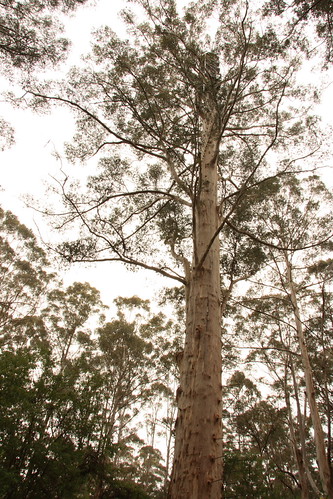
The Diamond Tree is just outside of Manjimup, and its viewing platform is 51 metres above the ground.
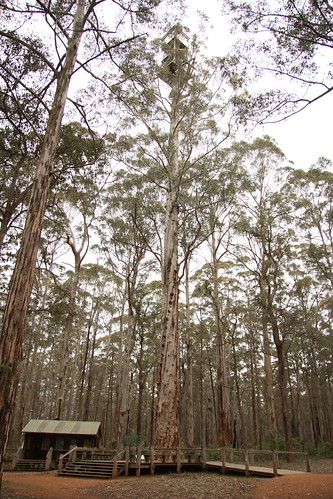
But the tallest is the Dave Evans Bicentennial Tree, with platforms at 30 and 68 metres above the ground.

To be honest, I was too scared to climb up any of these trees to the top – I could only manage the first 2 – 3 metres of all three of them.
I do like my tree burrs. There’s something very primeval about them. On east coast gums they’re fascinating. On giant west coast karri, they’re absolutely spectacular.


Getting back to the flora of the forest, we have some wattle – quite similar in hue to the east coast varieties…

And some delicate purple peas.

Occasionally we came across some felled trees. Apparently, sometimes the logs were so big that they couldn’t haul it out of the forest. The ring detail is fascinating. No wonder karri wood was (and still is) in such demand.

Unlike the rest of Western Australia, they generally get good rainfall in the south west, particularly during winter and spring. So it wasn’t so surprising to find some interesting fungi on the trees.


 Static and Silence