Even though it was a bright and brilliant day, it’s always cool and dark in the grove.

The strands of bamboo in the grove had been put to good use.


Even though it was a bright and brilliant day, it’s always cool and dark in the grove.
The strands of bamboo in the grove had been put to good use.
The creek itself looked very inviting.

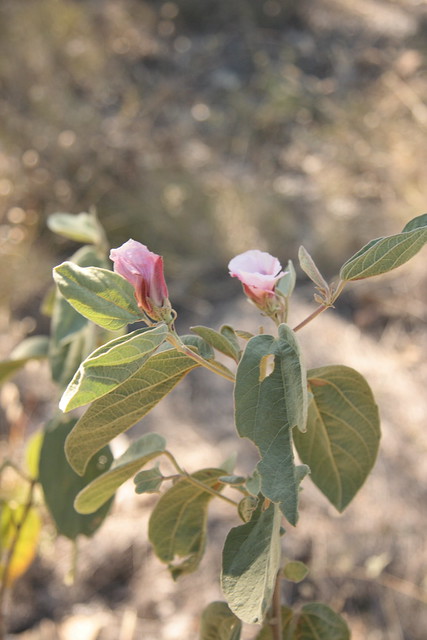
But there were also interesting things to look at beside the creek. This flower looks to be a weed, but it was pretty nonetheless.
And in the shade, I saw what seemed to be an old midden, going by the buried shells. The creek looked to be a resting place from way back.

We are going to revisit the creek at Adels Grove, this time in daylight.

As you can see, on a sunny day it’s a gorgeous place to be.
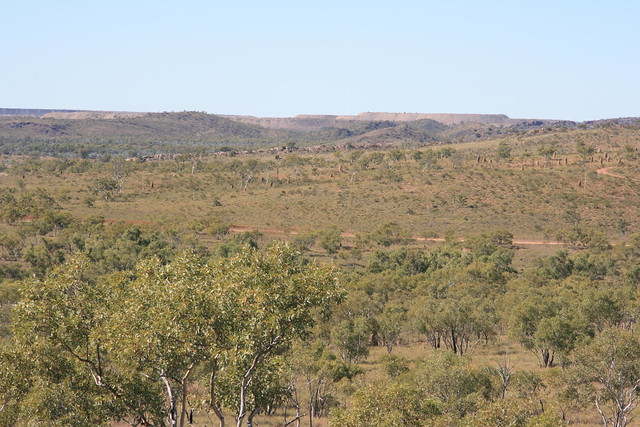
From the top of Lookout Hill, I could see the slag heaps of Century Mine on the horizon.

The mine is one of the biggest open-cut mines in Australia (perhaps the biggest), meaning it is a very, very big hole in the ground. They mine zinc and lead ore here, and it’s been going for 20 years.
Because it is an isolated place, and prone to flooding in the Wet, they had to build a lot of very clever infrastructure. They crush the ore and then dilute it with water. Then they pump it through 300km of pipes to Karumba in the Gulf of Carpentaria, where they ‘dewater’ the ore, put it on barges, and haul it 50km out to sea and on to the big export ships.
Hubby and a few of his colleagues got to go on a short visit, and he said the scale of everything, from the ‘tonka trucks’ to the big hole, was impressive. This is one of those operations where workers are flown in and out via their private airport, and where everything is self-contained.
The thing that got me about a mining operation like this is how efficient it was compared to, say, public transport in Sydney. I guess people in this country can make the effort to be efficient when there’s big money about. Public infrastructure however, makes no money, and so we’re left in the dark ages.
This mine is actually wrapping up operations pretty soon. But I doubt mining will disappear completely from the Lawn Hill area – there are plenty of other minerals about.
Those termite mounds are amazing. I can’t get enough of them.

But the sun was quickly setting, as it does in mid-winter, even this far north.

The shadows encroached further.

And further.

Until the sun disappeared over the horizon.

And sunlight disappeared from the plains.

The termite mounds really come into their own at this time of the day.

In this light, they remind me both of ancient standing stones, or a Martian landscape.

The moon rising behind made it an extra special sight.
Aside from termite mounds, there were some unusual grevilleas growing there.

These grevilleas seemed to only grow on rocky, sandy hillsides. We didn’t find them on the plains. They were certainly wild and pretty in the golden light.

One evening, we ventured out to Sunset Hill, just a kilometre from Adels Grove, to watch the sunset.

From the hill top, we could the termite mounds like sentinels, scrub, trees, and the sandstone escarpment in the distance.
I wasn’t out in the field everyday (I was on holidays after all), but I liked to see what people brought in at the end of the day. One afternoon, Hubby returned with slabs of Cambrian trilobites and brachiopods. I was very happy because trilobites are my favourite fossils.

I like their other-worldliness, these fossils being representatives from another time – when the Gulf Country and most of Eastern Australia was still under water, and when the only creatures on land were insects and spiders. Hubby suspected that there may be a new species in those slabs – he was only partially right.
This trilobite is a known species in the Gulf.

We’re yet to find out what species this is.

The ridged brachiopod (shell) is a known species, but those specimens came from western NSW. We’re yet to find out what species the smooth brachiopod is.

These are giant burrows of some kind. So far no one has any idea of what could have made them. It must have been big, scary thing, whatever it was.

And lastly, these are fossilised mud cracks! Surprising the things that survive.

The landscape at the last water bore we visited was flat.

Very flat.

I was later told that we were inside an impact crater from a meteorite which fell to earth hundreds of millions of years ago. Later I looked the area up on Google Maps, and what do you know, it did look like a crater. Whereas the surrounding hills were all in lines and curves, the hills around the crater was definitely a circle.
 Static and Silence