Stepping Back Into Time – Part 5

I thought that the Pomaks had an ancient way of life, but there was a lot of history to be had in Thrace. There were of course some remnants of Ancient Greece, like this amphitheatre in the coastal region of Maronia.

Maronia

But the Ancient Greeks weren’t the first to live in the region. Oh no, human history in this area went way back to the stone age. These first peoples weren’t Greeks but Thracians who came before them. Like in Stonehenge, these people worked with stone. We didn’t see any stone circles as such, but one look at the landscape would tell you why the ancient Thracians found Maronia so special.

Maronia

Maronia

Maronia

It looked as if a giant had just trampled through a mountain and tossed around a few boulders.

Maronia

Maronia

It also had olive groves that seemed to have been planted by the Ancient Greeks themselves.

Maronia

Maronia

We didn’t see another soul while we were there. Unfortunately some locals had started grazing their cattle there – a big shame since it meant that the area would be greatly damaged. But that’s the way it goes in Greece. If you know some one who knows some one and you can strike a deal between you all, then the rule book (if there was one in the first place) goes out the window.

Maronia

Mountain Food – Part 2

We weren’t only eating vegetables – that certainly won’t sustain you up in the mountains. We had our share of non-veg dishes too. This sausage was a bit like a chorizo, but perhaps more Turkish influenced.

Thracian Food

The chicken souvlaki was marinated with a mix of oregano and thyme – typical of Greece.

Thracian Food

This fried hard cheese I think tastes like haloumi, but harder.

Thracian Food

And of course, big chunks of goats milk feta.

Thassos Food

We had plenty of ‘schnitzels’ too. This one is made from pork with a mushroom and cream sauce.

Thracian Food

And the favourite lunch-time dish of herders, lamb chop stew with risoni.

Thracian Food

After all that eating, there really wasn’t any room for dessert. We only managed it once. Being in Greece, they were super-sweet.

Thracian Food

Mountain Food – Part 1

We ate at a lot of tavernas (old style/family-run eateries), and it was no different in the north of Greece. The decor though wasn’t white-washed at all, but something even more rustic.

Xanthi taverna

What was offered is quite similar to that down south, but with a cold weather twist. There of course lots of vegetables, some boiled…

Thracian Food

Thracian Food

Others grilled.

Thracian Food

Thracian Food

The grilled eggplant with feta was especially good – smoky and pungent. Greek food at its simple best.

Field Work in the Mountains

I must take my hat off to the geologists. As you’ve noticed by now, the terrain in the Rodophes wasn’t easy.

Gorgona Region

It’s rocky and steep, and the weather for most of the week was around 10C or colder on the hilltops. The only tracks to be had were ones made by goats, which on a precipice, made for a hair-raising walk.

Gorgona Region

Since my balance isn’t very good at the best of times, I didn’t really fancy being out all day in such conditions, so for most of the week I watched Hubby and P walk into the hills.

Gorgona Region

Meanwhile, I watched the scenery and the goats go by. Being in the mountains, the light changes constantly, providing many photo opportunities.

Gorgona Region

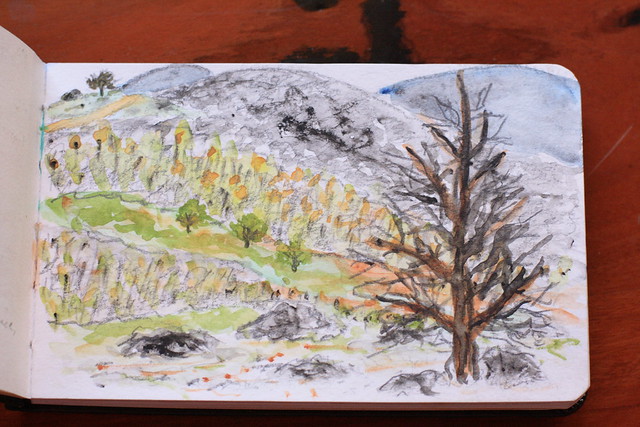
I also did some painting. Having bought a small set of watercolours and a pocket sketchbook in London, they came to good use.

Scenes from Thrace

Scenes from Thrace

At the end of the day, the satisfied geologists returned with several kilos of rock specimens. I was quite happy with a full page.

Scenes from Thrace

Stepping Back Into Time – Part 3

Let’s get a few more glimpses of how life is in the mountains for the Pomaks.

As I mentioned earlier, unlike the Christian Orthodox Greeks, the Pomaks are strictly Muslim. You can see a few mosques dotted in the mountains, and you can certainly hear the calls to prayer echoed via loudspeakers several times a day. So there’s no excuse not to pray, even if you’re away from the village tending your goats.

Gorgona Region

Thermes Region

Spring is a time to plough the fields and plant seeds for the coming year. There was plenty of evidence of agriculture in the mountains.

Thermes Region

Gorgona Region

Even though it’s less than 50km as the crow flies from the nearest city, the winding and precipitous roads make the region quite remote. Most Greeks have never visited this area, and up until 20 years ago, outsiders weren’t even allowed to enter, and that makes the Rodophes even more unworldly.

Gorgona Region

Gorgona Region

Thermes Region