What was left of Boydtown, Ben Boyd’s creation? Not much.

Within 10 years of his departure, all his buildings were left to rack and ruin.

What was left of Boydtown, Ben Boyd’s creation? Not much.
Within 10 years of his departure, all his buildings were left to rack and ruin.
Yes, Boyd’s Tower was magnificent, but in the end it was a white elephant.

Boyd’s empire collapsed a few years later, before the tower (designated to be a watch tower come lighthouse) could be fully utilised. He escaped the country for the California gold rush, but was unsuccessful there too. He disappeared while hunting what is now the Solomon Islands. His body was never found.

In the end, the tower was used by locals to spot whales. It was rather boring work, so the lads kept themselves occupied by playing chequers on a makeshift board.

You might wonder who the heck is Ben Boyd? The national park is of course named after him, and so are a lot of places in the Eden area. There’s Boyd’s Tower, for one.

Benjamin Boyd was a Scottish entrepreneur who came to Australia in the 1840’s, and came to Eden to establish a base for his whaling and grazing empire. You see, Twofold Bay, where Eden is situated, is a popular rest stop for whales. In fact, the Aboriginals have been hunting whales for centuries from dugout canoes. But hunting whales was a much larger enterprise for the settlers since the products of the whale were so profitable, and Boyd of course wanted to build the biggest whaling port ever.
One of the structures he commissioned was this tower, built on one of the headlands. No cost was spared – the sandstone blocks were quarried in Pyrmont, Sydney, and transported by steamer south. Some leftover blocks still lie near the tower.

The crowning glory of Ben Boyd National Park however has to be the Pinnacles – an eroded two-toned claystone cliff.

It’s amazing how colourful the clay was in contrast to the bleached white layer underneath and the blue of the sea and sky. The white layer was due to bleaching by groundwater many moons ago.

Despite this being a prime tourist attraction, we didn’t encounter another soul while we were there. That’s the beauty of the Sapphire Coast.
But wait, there’s more photos of this wonderful coastline in the Ben Boyd National Park. It might not seem like it from this photo, but we’re looking towards ‘civilisation’ – the towns of Pambula and Merimbula.

However on the other side all you see is miles of wild beach.
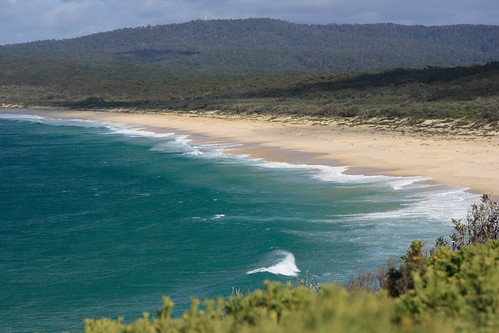
And between them is Haycock Point, with it’s bombola and pebbly beach with more of those wonderful rocks.

Another post about the lovely coastline in Ben Boyd National Park. First, some lovely weathered sandstone, although not as red as in my last post.

Now this is a wonder – folded and faulted rock.

And to round up the day, more foreshore boulders.

The Sapphire Coast, where Eden is situated, is not only resplendent in beaches but also in interesting rocks. Today we’re looking at the coastline in the Ben Boyd National Park, that surrounds Eden.

The colours, formations and types are so varied because the coastline here is older than the coast further north along the Sydney Basin. Hence we found sandstone so rich in iron oxide that they are a reddish-purple with veins of white quartz.

The pebbles on the foreshore are most colourful, too.

Walking around Eden, we saw plenty of coastal flora. Some, like the banksia, are native.

But some, like the red hot poker, aren’t, even though they grow well in the sandy, rocky landscape.

It was late afternoon by the time we reached our destination – the sleepy fishing port of Eden. And what a coastline it was. We had plenty of opportunity to enjoy it, since this was the view from our balcony.

Once again, I was at Brown Mountain, although this time I was heading for the coast, not the mountains. After crossing the treeless Monaro Plain, the wooded hills that lined the Bega Valley provided a welcome change of scenery.

 Static and Silence