At the end of the Charles Darwin walk I came across another waterfall, this time with a name: Weeping Rock Falls.

I suppose it’s because it falls rather gently over the rocks, or perhaps it’s a place of great sadness to someone or other? You decide.


At the end of the Charles Darwin walk I came across another waterfall, this time with a name: Weeping Rock Falls.
I suppose it’s because it falls rather gently over the rocks, or perhaps it’s a place of great sadness to someone or other? You decide.
I made a lunchtime visit to the State Library of NSW a few months ago, and was wonderfully surprised to find an exhibition about Charles Darwin, in particular, the time he spent in Australia while voyaging on the Beagle. It describes a visit he made to Wentworth Falls in 1836 while on the way to Bathurst. He wrote:
An immense gulf is suddenly & without any preparation seen through the trees… The class of view was quite novel & extremely magnificent.
High praise indeed from a man who had travelled extensively and was about to write a book that would change the world.
Having been to Wentworth Falls back in the autumn and seen the sign to the walk, I wanted to explore it for myself. It surprisingly starts off in the midst of civilisation – by the tennis court near the Great Western Highway.

I suppose there would have been no tennis courts back in 1836, nor would there have been any pine forests that the track passed through near the start, but it was quite lovely to have Jamieson Creek flowing alongside as it passes under overhangs and down little waterfalls.


It was also lovely to see the banksias and wattle out in force. Of course, there were plenty of birds taking advantage of the nectar. This one’s a lovely rosella.

Our final stop on the tour was Hat Head Hill, for a different perspective of the Grose Valley.

The soft winter light, Antarctic winds, and persistent showers made it quite an exhilirating experience.

That’s it from the photo tour. Yes, we covered plenty of territory and it was certainly worthwhile. Next time I’ll begin posting about NT.
Next stop was the Newnes State Forest and Blackfellows Cave, a large rock overhang featuring some Aboriginal rock art that was a nice precursor to my trip to NT.
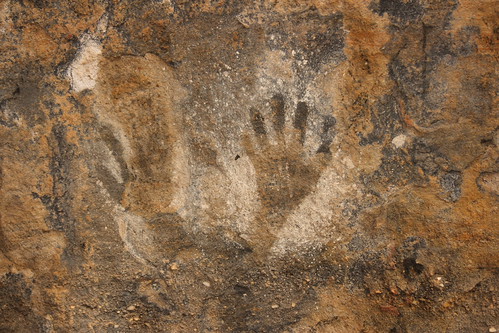
The area had some interesting flora and rock formations that reminded me of the Bungle Bungles, both the result of sandstone weathering over time.


The most unusual place we visited had to be the old Blast Furnace in Lithgow, which was where the first iron and steel in Australia was cast. The furnace was opened in 1886 and closed in 1928 when production was moved to Port Kembla.
The shell of the buildings, along with the dramatic lighting, produced some really striking images.


In the afternoon, we ventured down the stairs to take photos of Leura Cascades.

I had been here before, but it was good to be able to take the time and experiment with apertures and shutter speeds, as well as different angles. It made for a fun time.


Apologies for my absence. I’ve been on holidays for two weeks in the Northern Territory. Consequently I’ve got a ton of photos to organise, which will take time, but I can assure you that the results will be worth it.
In the meantime, I’m going to catch up on my trip to the Blue Mountains only a few days before I departed for NT. I went on a 2 day photo safari with Craig from River Deep Mountain High, and despite the cold and less than ideal light conditions, it was worthwhile.
The first place he took us was to the end of the long Mt Hay Road, to a place called Butterbox Canyon. Its heath country again on the edge of the Grose Valley.

Apart from magnificent views there was also interesting rock formations and flora around.


Banksias are ubiquitous to the east coast of Australia, where I live, but nevertheless are quite striking when in full flower.

Surprisingly, they are still striking even when their flowers have dried and withered.

Nowhere near the real Black Forest, but here is a fair imitation of the celebrated cake, at a very popular German bakery in Wentworth Falls.

The autumn colour was still out in force last weekend at Wentworth Falls. Beautiful maples and perfect light made it a pleasure to photograph.


