Tag Archives: flora

Winter Beach Visits – Part 2

There were plenty of people about, even on a cool, blustery morning. Kids were paddling in the shallow. There was a group of (what looked to be) little nippers training, and of course the occasional surfer. Off-shore, the tankers/cargo ships were lined up like ducks on the horizon.

Shelly Beach

The vegetation was of the usual beach kind, with lots of pig face about. It was nice to see them blooming.

Shelly Beach

Boodjamulla National Park

Boodjamulla (formerly Lawn Hill) National Park, is actually a very large place. It encompasses both the gorge area, Riversleigh fossil fields and beyond, all the way to the Northern Territory border.

A mere kilometre or so from the gorge, the landscape once again turns dry.

Lawn Hill Gorge

The geologists can’t help having a squizz at the rocks.

Lawn Hill Gorge

I was more interested in the flora. There were, once again, long wattles.

Lawn Hill Gorge

But I was more fascinated by this tree.

Lawn Hill Gorge

And the mottled bark pattern on its trunk.

Lawn Hill Gorge

Was it caused by insects or naturally occurring?

At Louie Creek – Part 4

From the previous posts, you can see that the landscape at Louie Creek is very diverse. So is the flora.

Unfortunately, it’s also overrun with weeds.

Louie Creek

Although the weeds can be pretty.

Louie Creek

The bark of the trees along the creek have interesting patterns which I have not seen before.

Louie Creek

But away from the creek this white gum ruled.

Louie Creek

But I liked the lilies best. Pity the flowers hadn’t begun to bloom as yet.

Louie Creek

Riversleigh Cook’s Tour – Part 3

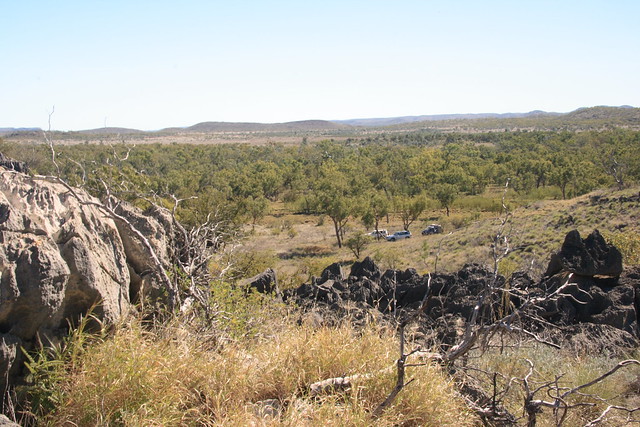
From above, the Riversleigh landscape seemed a bit uninspiring at first. It had none of the extraordinary coloured and shaped sandstone from Kakadu and Central Australia, or any extraordnary trees.

Cook's Tour

It was only up close that I learned to appreciate the different species. The gums with their pale trunks – different from the ones found in the Red Centre.

Cook's Tour

The acacia bushes, in bloom.

Cook's Tour

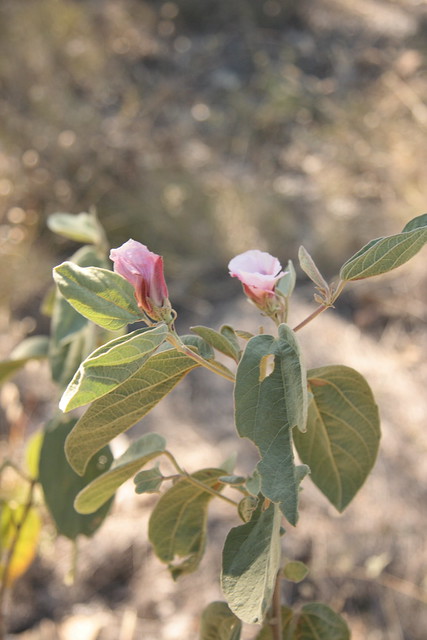
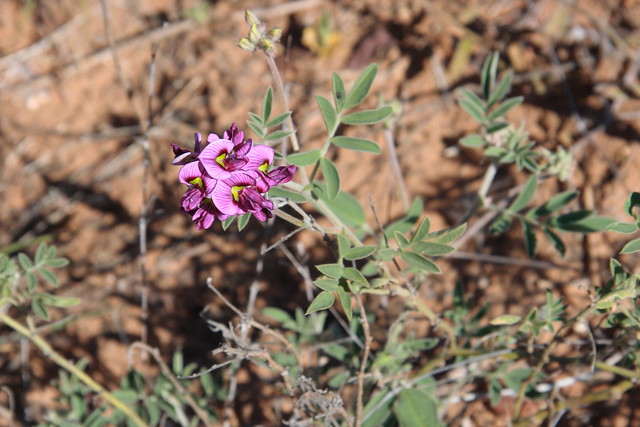
And other unusual flora.

Cook's Tour

But most common were the tuffs of spinifex. Sometimes they made eye-pleasing patterns on the hillside.

Cook's Tour

Riversleigh Cook’s Tour – Part 2

Mercifully, the tour was not all walking but was broken up by more of Mike’s anecdotes. At one site he found a mother and child diprotodon skeleton, just metres apart. When the local residents found out about the fossils and how they must have died together, they called it the Madonna and Child of Riversleigh. There were also stories told at previously worked sites like Camel Sputum (named by Henk, another palaeontologist, when he was in a particularly bad mood), and other curiously named localities, which together formed a loose history of the dig at Riversleigh. At each site, we saw bones peering out of the limestone, and proving that the ‘richness of the sites’ quoted in numerous articles wasn’t just hearsay.

Cook's Tour

We didn’t just learn about fossils though. The geologists were hard at work, seeking out flowstone – evidence of cave systems – that could be used to date the sites.

Cook's Tour

We saw more of the landscape – spinifex and acacia mostly.

Cook's Tour

And more of the trecherous limestone – I had to watch out for all those holes.

Cook's Tour

At lunch, our spider expert dug out a hairy native tarantula from under some Spinifex – in the name of research, of course – which became the prime attraction at the dinner table that evening.

Cook's Tour

All of this was very interesting, but for a person whose idea of exercise is a walk to the corner shop and back, it was also exhausting. I was ready for a big nanny nap. I might have an interest in palaeontology, but a field palaeontologist I was not meant to be.