Tsumago is certainly well-preserved. Walking around that morning I saw all sorts of quaint things.
A water wheel.

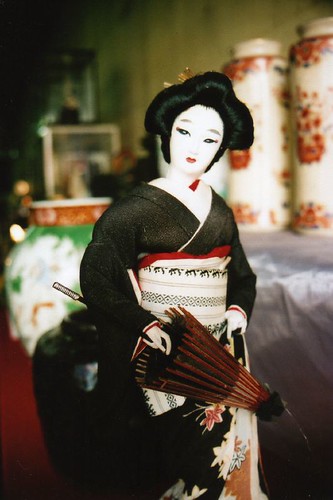
Some traditional dolls at the former village mayor’s house.

And a straw horse inside what I suppose were the old stalls.


Tsumago is certainly well-preserved. Walking around that morning I saw all sorts of quaint things.
A water wheel.
Some traditional dolls at the former village mayor’s house.
And a straw horse inside what I suppose were the old stalls.
On the subject of forgotten highways, we’re going to Japan now for a slow journey down the Nakasendo. The Nakasendo is the old highway in the main island of Honshu, Japan. It stretches between the ancient capital Kyoto and, at the time, the newer centre of Edo (now modern-day Tokyo). I’m only walking a small 8km stretch between the two mountain towns of Tsumago and Magome. Both of them are located in the Kiso Valley, north of Nagoya, and both of them have an extensive collection of heritage buildings.
Tsumago is the better preserved. The fact that they’ve managed to bury all their overhead cables means that on the surface it hasn’t changed much in appearance since samurais walked the streets. You can see the mountains looming close by. In winter this place inevitably gets cut off from the outside world by many feet of snow.

The buildings are all made of hardwood and the streets still cobblestoned. All in all, in makes for a very quaint atmosphere, in a quiet, Japanese kind of way.

Mind you, it isn’t always this deserted. Because of it’s heritage status it’s really a tourist village and no one (except for a few inn-keepers) actually lives here anymore. I didn’t stay in the village but close by, and was able to come back early one morning before the tourist hordes arrived.
We’ll end with the afternoon parade. Like the floats, the participants of the parade were colourfully clothed in their regional costumes. There was also a variety of age groups involved, from the very young…

To teens…

And last but not least, the not so young.

It made for a fascinating display.
Old Takayama is a maze of wooden two storey houses, filled with sake breweries, restaurants and craft shops.

They specialise in wooden homeware, like bowls and clogs.


And the most beautiful, and intricate, dolls.
However, sooner or later, the cult of Hello Kitty inevitably appears. Here, he’s even dressed in the regional attire.

In the morning, the floats were on display in the street. Each float ‘belongs’ to a Takayama family; knowing the Japanese, probably the old families of the town.

We got a first-hand look at how beautiful, intricate and unique each one was.
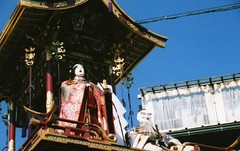


Luckily these floats get an airing twice a year, in April and October, so that locals and visitors alike can marvel at its beauty.
We’ll have a look at more market produce today.
There are decorative reeds with little dolls that are a speciality of the town.

This obaasan (grandmother) was selling some corn posies.

Actually, there were plenty of decorative corn for sale.

But I was more fascinated by the boxes of wasabi. Yep, that’s what they look like fresh. The paste that we get in Australia is actually dyed horseradish.

By day, Takayama is a pretty and vibrant place.
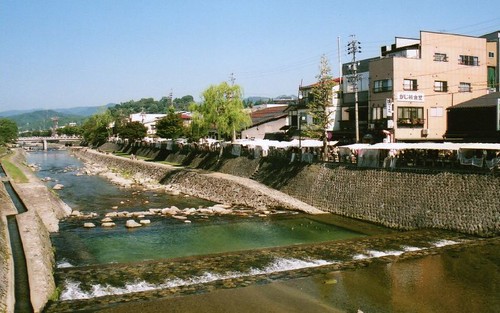
Children feed the fish in the river.

And when they get hungry themselves, they line up for grilled mochi (with a soy glaze) on a stick. Mochi is rice pounded until it reaches a springy, dough consistency. Then it can be glazed and grilled…

Or it can be made into a sweet. We watch an expert sweet mochi maker ply his trade. By the time he finishes dicing the batch we knew we had to try some.

Takayama is a town in Gifu Prefecture, in the middle of the Japanese Alps. It’s claim to fame is its sake and its elaborate autumn and spring festivals. On my trip to Japan in 2006 I was lucky enough to visit during the autumn festival. The streets were filled with vendors of all kinds, but the food stalls were of the most interest to me!
This one is making red bean or custard filled little buns.

Charcoal grilled freshwater fish.

Traditional paper dolls.

But the main attraction at night were the giant floats that were hauled through the streets.

Later on we’ll be studying them close up in daylight.
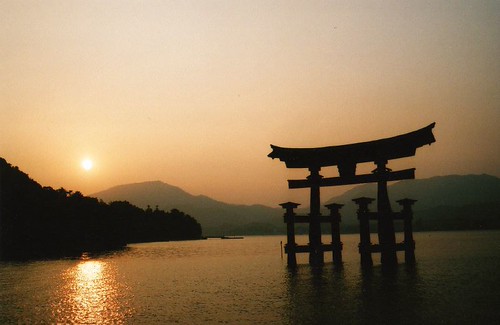
All good things must come to an end, and soon it was time to get back on the ferry to the mainland. But before we left we were graced with a beautiful sunset, and a view that is one of the most revered in Japan.
Speak no evil, see no evil, hear no evil: a warning, or a proverb?

 Static and Silence