Twilight at Adels Grove – Part 4

Luckily, the swimming areas were unaffected. This was where I was to spend a few happy afternoons. The spring-fed waters of the creek was beautiful to swim and float in. I also enjoyed the passing parade of zebra-striped archer fish and the occasional canoeist.

Twilight

Surprisingly, not too many visitors were keen to brave the water. At eighteen degrees Celsius, most of the holidaying Queenslanders thought the water too brisk for even a five minute swim. I thought the water cool but refreshing – Sydney beaches were as cold, if not colder, in the middle of summer. Besides, I wasn’t going to miss an opportunity to swim in a beautiful creek. You certainly don’t get water as clean and sweet as Lawn Hill Creek down south.

Twilight at Adels Grove – Part 3

The creek might have been a peaceful place at Adels in the dry, however downstream, I saw plenty of evidence of recent destruction in the wet. The rains were so persistent that it brought the water level up to five metres or more above dry season levels.

Twilight

It meant that banks were severely eroded to expose tree roots, and twenty metre trees seemed like play things, many being uprooted and swept away downstream.

Twilight

Twilight at Adels Grove – Part 1

Our home away from home while in the field was at Adels Grove, about 40km north east from Riversleigh. It’s a sizeable accommodation complex by Lawn Hill Creek, with camp sites, permanent tents and motel rooms. To take advantage of the good, dry season weather, they have a large deck, where meals and entertainment are held.

Twilight

The property itself was first established by Frenchman Albert de Lestrange in 1920 (‘Adels’ are his initials). He dreamed of planting a botanical garden in the Savannah, and by the late 1930’s had planted over 1000 different varieties of both exotic and native plants. Unfortunately, the locals were very suspicious of Albert, and in the early 1950’s a fire destroyed his dwelling and much of the property (some say it was deliberately lit). Albert was forced away to Charters Towers, where he lived in a nursing home until his death in 1959. Fortunately, some of his plants survived him, and the beautiful, shady grove is his legacy.

Twilight

Riversleigh Cook’s Tour – Part 3

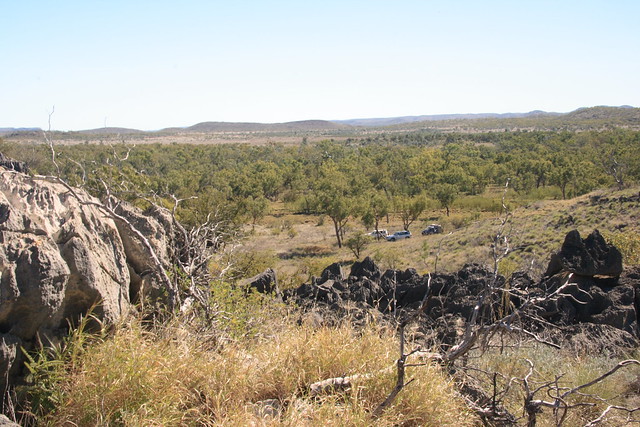
From above, the Riversleigh landscape seemed a bit uninspiring at first. It had none of the extraordinary coloured and shaped sandstone from Kakadu and Central Australia, or any extraordnary trees.

Cook's Tour

It was only up close that I learned to appreciate the different species. The gums with their pale trunks – different from the ones found in the Red Centre.

Cook's Tour

The acacia bushes, in bloom.

Cook's Tour

And other unusual flora.

Cook's Tour

But most common were the tuffs of spinifex. Sometimes they made eye-pleasing patterns on the hillside.

Cook's Tour

Riversleigh Cook’s Tour – Part 2

Mercifully, the tour was not all walking but was broken up by more of Mike’s anecdotes. At one site he found a mother and child diprotodon skeleton, just metres apart. When the local residents found out about the fossils and how they must have died together, they called it the Madonna and Child of Riversleigh. There were also stories told at previously worked sites like Camel Sputum (named by Henk, another palaeontologist, when he was in a particularly bad mood), and other curiously named localities, which together formed a loose history of the dig at Riversleigh. At each site, we saw bones peering out of the limestone, and proving that the ‘richness of the sites’ quoted in numerous articles wasn’t just hearsay.

Cook's Tour

We didn’t just learn about fossils though. The geologists were hard at work, seeking out flowstone – evidence of cave systems – that could be used to date the sites.

Cook's Tour

We saw more of the landscape – spinifex and acacia mostly.

Cook's Tour

And more of the trecherous limestone – I had to watch out for all those holes.

Cook's Tour

At lunch, our spider expert dug out a hairy native tarantula from under some Spinifex – in the name of research, of course – which became the prime attraction at the dinner table that evening.

Cook's Tour

All of this was very interesting, but for a person whose idea of exercise is a walk to the corner shop and back, it was also exhausting. I was ready for a big nanny nap. I might have an interest in palaeontology, but a field palaeontologist I was not meant to be.

Riversleigh Cook’s Tour – Part 1

After our visit to ‘D’ site, we drove back a mile along the main road before entering a gate into what looked to me like a wilderness. Then setting the four wheel drive into gear, we bashed through plains of grass seven feet tall, ducked in and out of dry creek beds, and swerved around termite nests. It might have only been a fifteen minute ride, but to a four wheel drive novice passenger like me, it seemed like an endless, bumpy drive into nowhere. It was only later that I found out that there was science in the madness – we had followed a well-known track, which due to a bumper wet season was grossly overgrown. Aside from the natural impediments, there were also man-made impediments. Some of the gates that we drove through were so complex to open that it seemed like you needed a degree to do so successfully. I quickly realised that the Gulf country was rougher than I thought.

Eventually, we stopped at a limestone ridge called the Bite-Centennial Gallery. This site produced the first big finds after ‘D’ site.

Cook's Tour

Mike, our guide for the day, was one of the key palaeontologists behind the Riversleigh finds. He has returned here at least once a year for the last 36 years. You’d say that he was fountain of knowledge about the area, but he was also an amusing story teller.

Cook's Tour

At Bite-Centennial Gallery, he began by recounting the disturbing story behind the name (involving a drunken, biting cattleman, a distressed geologist, and a decapitated yabby), before we walked up the ridge, which for me was when the fun started.

Cook's Tour

I have never been a rock wallaby. I like being in the outdoors, but I’m more comfortable with gentle strolls along established paths than bush bashing across the wilderness. And worse still, an ankle injury six months before had made me more hesitant on my feet than usual. You can guess that my first hour at the Gallery was not terribly fun. Grasses constantly pricked my short legs, their seeds covered my trousers and top, and the razor-sharp limestone cut my hands when I touched them. This certainly was not what I was expecting.

I learned my lesson quickly though. The next day, I wore gaiters to the field, and my shins certainly thanked me for it.

Riversleigh ‘D’ Site – Part 3

Riversleigh in the Miocene wasn’t anything like the dry plains that we see today. Think the Daintree region of Far North Queensland, where the rainforest meets the sea, and you get an idea what the landscape was like 25 million years ago. At Riversleigh, you can even see some fossilised wave action.

D Site

As for the fauna, it was rather different. Aside from the big bird, there were big snakes, wombats, kangaroos, and crocodiles. The long-nosed animal is my old friend, the palorchestes, related to the koala.

D Site

Riversleigh ‘D’ Site – Part 2

The Riversleigh fossil sites are now under the management of national parks. Unfortunately, some people seem to disregard the rule of not taking anything without permission, hence the sign below.

D Site

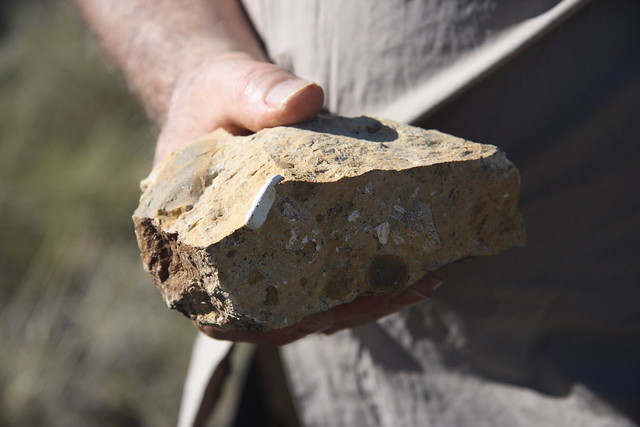
Apparently, people have lifted huge slabs, without remorse before. ‘D’ Site is the only site in Riversleigh open to the public, and the first that was worked on. Back in 1976, a group of palaeontologists from the Queensland Museum came out to explore a tip-off they got from one of their colleagues, who found lots of bone in the limestone years before, but didn’t bother to pursue it further because he thought bones in limestone were impossible to extract.

This was what he saw.

D Site

D Site

Luckily, the QM paleos were more persistent, and they discovered lots of bone peeking out from the rock. And discovered more creatures from Miocene Australia (around 25 million years ago).

D Site

These bones are the leg bone of a dromornis – a giant bird that weight over 500kg, with a lethally big beak. So big and lethal in fact that the scientists nicknamed it the ‘Demon Duck of Doom’ (it might be distantly related to modern ducks).

Here it is fighting with a crocodile!

D Site