Category Archives: Uncategorized

Walk to Lookout Hill – Part 3

Past the wattle bushes, I encountered the first termite mound of the walk. Termites in Australia are very industrious creatures, and the best examples of their work are in the north of Australia. The mounds around Adels Grove aren’t massive (I’ve seen 3 metre high ones by the roadside) but it is a good example of a typical Savannah landscape.

Walk to Lookout Hill

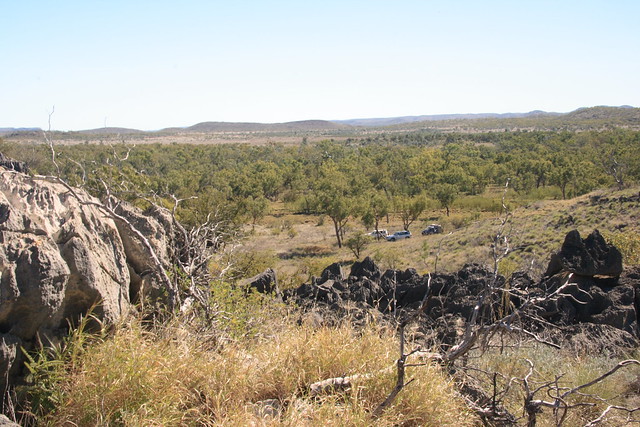
As I started to climb Lookout Hill, I saw more of the surrounding landscape, and how quickly it changed. The strand of trees running through the middle of the shot (some 200 metres away) was where Lawn Hill Creek ran. Yet on the hill, all was dusty and rocky.

Walk to Lookout Hill

Walk to Lookout Hill – Part 1

We’re starting a walk to Lookout Hill this week, but the walk really started from our tent. We stayed in one of the permanent safari tents on the site. As you can see, it was a big family tent and very comfy, especially when it was only for the two of us. It was made up with proper beds and bedding. I’m a big fan of ‘glamping’, I must say.

Permanent Tent

But a tent is a tent, and as Joan noted on her recent road trip to Central Queensland, it’s been a bit cold this winter, even in the Outback. Hubby said that it was the coldest visit he’s ever had to the area, and it was his sixth trip. Temperatures got down to as low as 5C during the night, but rose to the mid 20C’s by the afternoon. I was just thankful for the clear weather after living through months of rain down in Sydney.

Twilight at Adels Grove – Part 4

Luckily, the swimming areas were unaffected. This was where I was to spend a few happy afternoons. The spring-fed waters of the creek was beautiful to swim and float in. I also enjoyed the passing parade of zebra-striped archer fish and the occasional canoeist.

Twilight

Surprisingly, not too many visitors were keen to brave the water. At eighteen degrees Celsius, most of the holidaying Queenslanders thought the water too brisk for even a five minute swim. I thought the water cool but refreshing – Sydney beaches were as cold, if not colder, in the middle of summer. Besides, I wasn’t going to miss an opportunity to swim in a beautiful creek. You certainly don’t get water as clean and sweet as Lawn Hill Creek down south.

Twilight at Adels Grove – Part 3

The creek might have been a peaceful place at Adels in the dry, however downstream, I saw plenty of evidence of recent destruction in the wet. The rains were so persistent that it brought the water level up to five metres or more above dry season levels.

Twilight

It meant that banks were severely eroded to expose tree roots, and twenty metre trees seemed like play things, many being uprooted and swept away downstream.

Twilight

Twilight at Adels Grove – Part 1

Our home away from home while in the field was at Adels Grove, about 40km north east from Riversleigh. It’s a sizeable accommodation complex by Lawn Hill Creek, with camp sites, permanent tents and motel rooms. To take advantage of the good, dry season weather, they have a large deck, where meals and entertainment are held.

Twilight

The property itself was first established by Frenchman Albert de Lestrange in 1920 (‘Adels’ are his initials). He dreamed of planting a botanical garden in the Savannah, and by the late 1930’s had planted over 1000 different varieties of both exotic and native plants. Unfortunately, the locals were very suspicious of Albert, and in the early 1950’s a fire destroyed his dwelling and much of the property (some say it was deliberately lit). Albert was forced away to Charters Towers, where he lived in a nursing home until his death in 1959. Fortunately, some of his plants survived him, and the beautiful, shady grove is his legacy.

Twilight

Riversleigh Cook’s Tour – Part 3

From above, the Riversleigh landscape seemed a bit uninspiring at first. It had none of the extraordinary coloured and shaped sandstone from Kakadu and Central Australia, or any extraordnary trees.

Cook's Tour

It was only up close that I learned to appreciate the different species. The gums with their pale trunks – different from the ones found in the Red Centre.

Cook's Tour

The acacia bushes, in bloom.

Cook's Tour

And other unusual flora.

Cook's Tour

But most common were the tuffs of spinifex. Sometimes they made eye-pleasing patterns on the hillside.

Cook's Tour

Riversleigh Cook’s Tour – Part 2

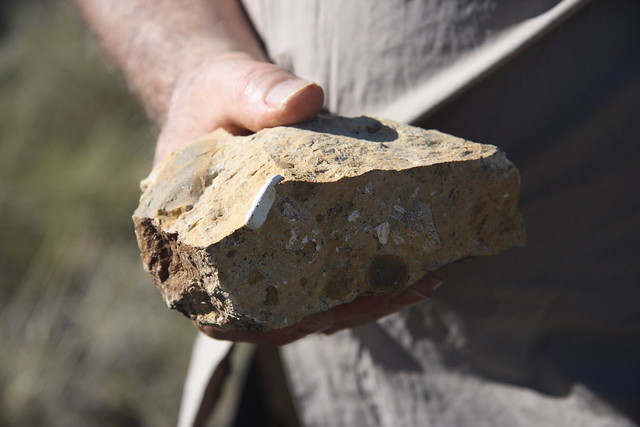
Mercifully, the tour was not all walking but was broken up by more of Mike’s anecdotes. At one site he found a mother and child diprotodon skeleton, just metres apart. When the local residents found out about the fossils and how they must have died together, they called it the Madonna and Child of Riversleigh. There were also stories told at previously worked sites like Camel Sputum (named by Henk, another palaeontologist, when he was in a particularly bad mood), and other curiously named localities, which together formed a loose history of the dig at Riversleigh. At each site, we saw bones peering out of the limestone, and proving that the ‘richness of the sites’ quoted in numerous articles wasn’t just hearsay.

Cook's Tour

We didn’t just learn about fossils though. The geologists were hard at work, seeking out flowstone – evidence of cave systems – that could be used to date the sites.

Cook's Tour

We saw more of the landscape – spinifex and acacia mostly.

Cook's Tour

And more of the trecherous limestone – I had to watch out for all those holes.

Cook's Tour

At lunch, our spider expert dug out a hairy native tarantula from under some Spinifex – in the name of research, of course – which became the prime attraction at the dinner table that evening.

Cook's Tour

All of this was very interesting, but for a person whose idea of exercise is a walk to the corner shop and back, it was also exhausting. I was ready for a big nanny nap. I might have an interest in palaeontology, but a field palaeontologist I was not meant to be.