One evening, we ventured out to Sunset Hill, just a kilometre from Adels Grove, to watch the sunset.

From the hill top, we could the termite mounds like sentinels, scrub, trees, and the sandstone escarpment in the distance.

One evening, we ventured out to Sunset Hill, just a kilometre from Adels Grove, to watch the sunset.
From the hill top, we could the termite mounds like sentinels, scrub, trees, and the sandstone escarpment in the distance.
I wasn’t out in the field everyday (I was on holidays after all), but I liked to see what people brought in at the end of the day. One afternoon, Hubby returned with slabs of Cambrian trilobites and brachiopods. I was very happy because trilobites are my favourite fossils.

I like their other-worldliness, these fossils being representatives from another time – when the Gulf Country and most of Eastern Australia was still under water, and when the only creatures on land were insects and spiders. Hubby suspected that there may be a new species in those slabs – he was only partially right.
This trilobite is a known species in the Gulf.

We’re yet to find out what species this is.

The ridged brachiopod (shell) is a known species, but those specimens came from western NSW. We’re yet to find out what species the smooth brachiopod is.

These are giant burrows of some kind. So far no one has any idea of what could have made them. It must have been big, scary thing, whatever it was.

And lastly, these are fossilised mud cracks! Surprising the things that survive.

The landscape at the last water bore we visited was flat.

Very flat.

I was later told that we were inside an impact crater from a meteorite which fell to earth hundreds of millions of years ago. Later I looked the area up on Google Maps, and what do you know, it did look like a crater. Whereas the surrounding hills were all in lines and curves, the hills around the crater was definitely a circle.
The week however wasn’t all about palaeontology. I also joined the geologists on a few of their water and rock collecting trips. They sampled water from the local creeks, took rocks from the surrounding area, and attempted to collect data from the monitoring devices they had left in various water bores the previous year. These monitors tracked water levels and pressure and temperature.
It was the last activity that took the most time – the monitoring devices were frustratingly difficult to retrieve. These devices were basically suspended into the bores with a length of rope and then taped into place. To retrieve them involved a lot of fishing about.

Unfortunately, their survival rate was low. If they hadn’t detached from the rope, chances were that the bore they were in had been trampled by a herd of cattle. Even if you retrieved the monitor, you might not be able to extract the data from it.


In the end, only one device out of five came up with the goods. I guess it’s pot luck out in the Outback.
We drove east towards Gregory Downs. Along the way, we saw more termite mounds than you can poke a stick at.


On the way back to Adels Grove, we stopped by an abandoned mine called Lilydale. Back in the turn of the 20th Century, Lilydale was a silver, lead and zinc mine that supported hundreds of miners. The only problem (and it was a big one) was lack of water. The nearest creek or river was at least 10km away, and as a consequence many miners died of thirst, and the mine was eventually abandoned.

All that was left were the trenches where they dug, the small mounds of slag, and the odd scrap of metal.

As with many ventures in the Outback, this was one that nature won.

There were quite a few species blooming in the Dry, only I wasn’t sure which were natives and which were introduced (and so a weed). Which, do you think, is which?

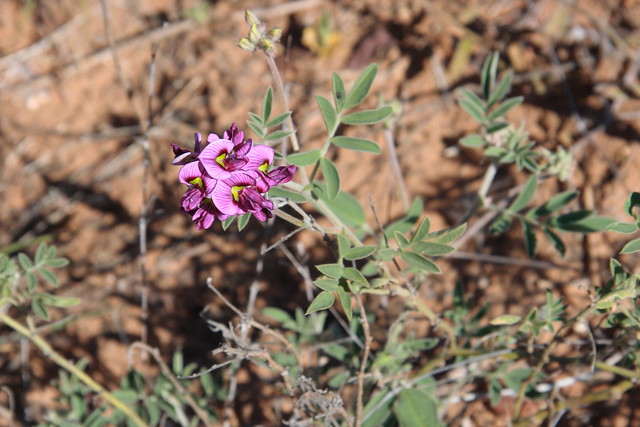

Isn’t it funny that they’re all a shade of pink-purple, out here in the arid areas?
Glimpsing their haul from the previous day, I saw that all the significant finds were neatly marked for sorting and transportation. There were piles and piles of rock, exposing jaws, teeth, and vertebrae.
A jaw bone.

Cross-section of bone (from a giant leg?).

A vertabra.

As the morning drew on, the pile of ‘potential’ rocks grew, but as a novice, I couldn’t identify anything without professional help. Later, I found out that the team had found the jaw of a nimbadon (a sheep-sized diprotodon), but unfortunately for me it had already been bagged-up, ready for transportation.
What were inside those rocks? It was frustrating that unlike at Wellington Caves, where the fossils were preserved in loose sediment that could easily be washed away, extracting fossils from limestone required time and effort. I guess it’s like the difference between digital and film photography. Wellington was like digital photography, where you could almost instantaneously view your finds. However the fossils in Riversleigh limestone, like developing film, required the rocks to be transported back to the labs at UNSW, where they would be submerged numerous times in a weak acid solution. Eventually the limestone would dissolve to reveal the bones inside it. Like an expectant photographer developing film, hopefully I can one day visit UNSW to get a glimpse of this year’s finds. It would really round-off my Riversleigh experience.
I got to see more of the dig team in action the next day when we visited a site called South GAG Plateau. Early in the morning, there was a lot of scanning for potential sites. It also meant the carrying of equipment, including crow bars.

Unfortunately, there wasn’t anything being blown up that morning, so Lizard, the bushy-bearded explosives expert, wasn’t called to do anything more strenous than haul a few rocks.

That didn’t stop the eager palaeontologists and volunteers from wielding sledgehammers, crow bars, geo-picks, and shovels in an effort to extract more rocks.


After breaking the limestone into manageable chunks, they would carefully examine each piece to see whether it had bone (and hence ‘potential’).

What were inside those rocks?
At the top of the hill, I could see the country side in all its glory – the lush grove, the dry plains beyond, and the sandstone plateau on the horizon.

The sandstone plateau wasn’t as dramatic as those in Central Australia, but it did yield a lot of good things, which I will post about in the future.

 Static and Silence