Tag Archives: geology

Saxony – Part 2

We didn’t stay in Dresden long though, as our destination was the small town of Freiberg, 30km away.

Walking around Freiberg

Walking around Freiberg

This pretty town made its fortune from its silver mines which had been in operation since the Middle Ages. The town’s university still has a school of mining operating.

Walking around Freiberg

Walking around Freiberg

Given its wealth, there was a lot of intricate decoration. The East Germans loved the town so much that they even restored the town to its full glory in the 1980s, when much of the country was neglected.

Walking around Freiberg

Walking around Freiberg

It was our first taste of Germany. More to come.

Santorini – Part 2

Hubby was certainly fascinated by the geological aspects of the Santorini eruption, and certainly the signs of a massive eruption was all around, if you know what to look for. To begin with, the soil on the island was all made of volcanic ash. In fact the ash layer was perhaps 50 metres thick. You can see it in this quarry. All those layers under the buildings are all ash.

Fira

The volcano before the eruption must have been very big. Hubby says it would have looked like any other volcano cone, perhaps like the shape of Mount Fuji, but bigger. You can get a taste of the scale of the volcano from various high points on the island.

Caldera View

Santorini Clifftops

We could see the shape of the caldera clearly curve around from the village of Pyrgos, which we will visit later.

Pyrgos Kallistis

Pyrgos Kallistis

Whichever way you look at the island, Santorini is certainly impressive.

Santorini – Part 1

We’ve finally made it to our final destination, in Greece at least – the island of Santorini. Santorini is what Greek holiday dreams are made of – stunning location, generally good weather, and large selection of accommodation and activities. That also meant that there was bound to be crowds all year round. We certainly weren’t sure of what we would find in April, but we were pleasantly surprised.

Our hotel was a pretty plush affair, and postcard-perfect, if it wasn’t for the 30km/h winds and mid-teen temperatures that greeted our arrival.

Fira

We didn’t have a ‘caldera view’ despite the plushness, but a quick walk across the road remedied that.

Fira

Santorini is of course the main island of what was once the rim of a super volcano. The volcano infamously imploded upon itself around 4000 years ago, wiping out the Minoan civilisation, and creating the caldera (a flooded volcano) that we see today. Since then a mini volcano has started growing in the middle, so Santorini isn’t quite dormant yet. An active volcano doesn’t seem to put off the cruise ships – it’s the favourite destination of many Mediterranean cruises.

The towns on the island are mainly perched high upon the rim. We stayed near the main town of Fira where the houses were built staggered down the cliff-side. That made for a lot of stair-walking.

Fira

We’ll be exploring the town and its surrounds in the next few posts.

The Natural History Museum – Part 2

The Natural History Museum is huge, with galleries full of old-school stuffed animals, dinosaur galleries (bones and all), reconstruction of blue whales, as well as enormous displays of minerals, precious gems, and interactive earth sciences exhibits. There were so many galleries in fact that it made my head spin. But given our recent trip to Lyme Regis, and my acquaintance with the story of Mary Anning, it was the marine reptile gallery that I found the most memorable.

Marine Dinosaur Gallery

It’s quite a simple gallery really – a light and airy space, it has mounted on its walls complete fossils of marine dinosaurs. In fact, it houses the actual fossils that Mary Anning found in the cliffs of Lyme Regis, 200 years ago.

Marine Dinosaur Gallery

Marine Dinosaur Gallery

Here was the head of the first full ichthyosaur fossil that she found with her brother when she was just twelve years old.

Marine Dinosaur Gallery

And above it was another ichthyosaur that she found in Lyme Regis. The details are fascinating – the teeth, the ammonites embedded on to the ichthyosaur, showing that the two very different creatues did co-exist 200 million years ago.

Marine Dinosaur Gallery

Marine Dinosaur Gallery

Marine Dinosaur Gallery

I actually got a bit emotional seeing ‘her’ creatures in the most hallowed natural history museum in Britain, knowing how she struggled to make her mark. It goes to show that Mary Anning’s contribution, although not fully acknowledged in her lifetime, is now celebrated.

Fossil Hunting – Part 3

It was a great day to be wandering along the beach, even if conditions weren’t optimal for fossil hunting. After two weeks of grey skies, the sun was greatly appreciated.

Fossil hunting in Lyme

We headed for the cliffs called the Black Ven. You can see the layers of bedding really clearly – they are interlacing layers of limestone and shale from Jurassic times. It is also very unstable, and as you can see there have been landslides here for eons.

Fossil hunting in Lyme

It was where Mary Anning found quite a few of her specimens. The species we found a lot of were ammonites – they were everywhere! They came in many forms:

Impressions of ammonites in the shale (a sedimentary rock). These were very fragile and aren’t worth keeping, but were pretty nevertheless.

Fossil hunting in Lyme

Pyritised ammonites that have been fossilised into pyrite (ie. Fool’s gold). These can be kept!

Fossil hunting in Lyme

More impressions of ammonites, this time in siltstone (also a sedimentary rock, with a grain size in between sandstone and shale).

Fossil hunting in Lyme

Fossil hunting in Lyme

There were also impression of leaves.

Fossil hunting in Lyme

And we did find a dinosaur fossil – a limb bone from a marine reptile. It’s surrounded by fossil crinoids (a species we found a lot of in Australia).

Fossil hunting in Lyme

Unfortunately, the slab that the fossil was in was big – there was no way we could have slipped it into our suitcase. But we did take back a few ammonites, which are now on display in Sydney.

We’d lost track of time (and so did Paddy, our guide), and when we looked at our watches, three hours had gone by. It was time to head back before the rising tide caught us. But before we leave the beach, and Lyme Regis, we took one last look at the Jurassic Coastline.


Fossil hunting in Lyme

Fossil Hunting – Part 1

We weren’t taking just a walk along the beach – we wanted to search for fossils. The area is called the Jurassic Coast for a reason – it’s shores are actually seabeds from the Jurassic, the time of the dinosaurs. A quick look at the museum or in the numerous fossil shops show the range of creatures to be found. The most impressive of those is the ichthyosaur, a marine dinosaur that’s the shape of a dolphin.

Morning at Lyme Regis

Lyme Regis is the first place that it was discovered, back in the early 1800’s, by an extraordinary lady called Mary Anning.

Morning at Lyme Regis

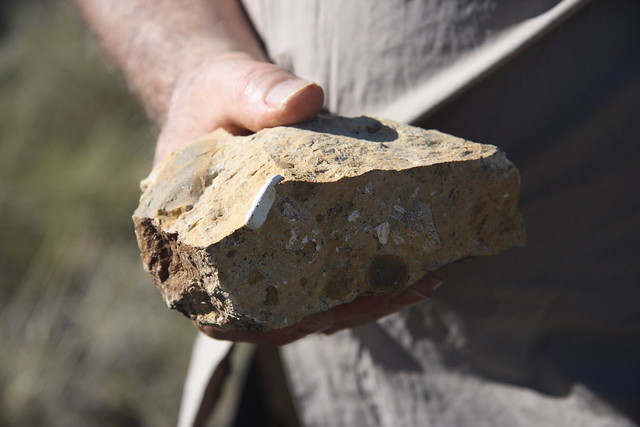
Mary’s story is a fascinating one. I first became acquainted with it while reading Tracy Chevalier’s novel, Remarkable Creatures. She wasn’t an Oxbridge professor, but a working-class woman. Her father was a carpenter and sold fossils to tourists. The family lived on the site of the current Lyme Regis museum, right by the sea.
Morning at Lyme Regis

Mary became proficient at an early age in finding these fossils on the beaches of Lyme. When she was just twelve, Mary and her brother found their first ichthyosaur, intact, in the nearby cliffs. As Mary grew older and found more of these extraordinary creatures, Mary, and other scientists of the day who studied it, began to question their belief that God made the earth and all its creatures in seven days. Surely something that was encased in rock, that seemed to have no equivalent in the contemporary world, would have walked the earth thousands of years before us, not merely six?

This kind of thinking was dangerous of course, and it made Mary a renegade and outsider all her life. She was rarely acknowledged even as the source of the specimens, even though she led many scientists and visitors along the beach. Despite this, she continued with her work, finding other ichthyosaurs and other dinosaur species in the process. Her contribution to the science of paleontology may not have been acknowledged in her lifetime, but in the 21st Century she is an icon, and a source of inspiration to me.

Morning at Lyme Regis

Next, we’ll follow in Mary’s footsteps and see if we can find any fossils.

Water Monitoring

The week however wasn’t all about palaeontology. I also joined the geologists on a few of their water and rock collecting trips. They sampled water from the local creeks, took rocks from the surrounding area, and attempted to collect data from the monitoring devices they had left in various water bores the previous year. These monitors tracked water levels and pressure and temperature.

It was the last activity that took the most time – the monitoring devices were frustratingly difficult to retrieve. These devices were basically suspended into the bores with a length of rope and then taped into place. To retrieve them involved a lot of fishing about.

North of Century Mine

Unfortunately, their survival rate was low. If they hadn’t detached from the rope, chances were that the bore they were in had been trampled by a herd of cattle. Even if you retrieved the monitor, you might not be able to extract the data from it.

Water monitoring

Water monitoring

In the end, only one device out of five came up with the goods. I guess it’s pot luck out in the Outback.