All posts by Sandra Graham

I am an artist and blogger living in Sydney, Australia. I am interested in Australian landscapes and lost suburbia, capturing them in photographs, paintings, prints and mixed media. @s_graham_art

Athina – Part 2

The Acropolis isn’t just about the Parthenon – there are other temples there as well. We entered the complex through the Propylaea, the main gates.

On the Acropolis

Through it, you can see the city and the mountains.

On the Acropolis

Athens does seem to go on forever nowadays, but not long before, it occupied only the immediate valleys.

On the Acropolis

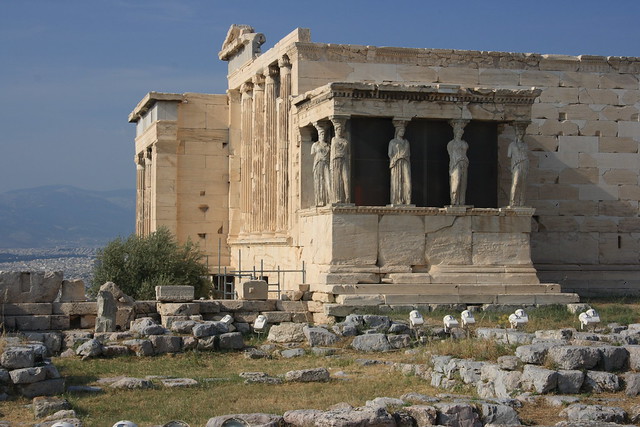
The Erechteion is the most well-preserved, and I think most beautiful, of all the existing temples.

On the Acropolis

However, the Ancient Greeks weren’t the only ones to build here. Down below are the remains of two Roman amphitheaters. This one, the Odeon of Herodes Atticus, is still used for concerts in the summer.

Odeon of Herodes Atticus

The Acropolis however isn’t the only thing to see in Athens. I’ll show you some more sights in my next post.

Athina – Part 1

Welcome to Greece, and to Athens! It certainly was a change, coming to almost sultry Athens from cold London. The light, the people, the atmosphere, the history, the food, the traffic; yes, it was all different from the UK.

On the Acropolis

We’ll start off at the top – on top of the most famous landmark in the city, the Acropolis. As you can see from the view above, the Acropolis is a hill on which the ancient temples stood. The most (in)famous of them being the Parthenon.

On the Acropolis

Given that the building is some 2500 years old, it needed a bit of maintenance and restoration.

On the Acropolis

The temple is being pulled apart piece by piece, and then joined back together using laser technology – a costly business considering how many pieces there were left to be joined back together.

On the Acropolis

This is also the scene of some daylight robbery by the British. The Greeks, as you can see, want the stolen friezes back, but as I explained before, the British are having none of it.

On the Acropolis

Consequently, all the friezes still in Athens are now housed in a special museum just down the hill. The New Acropolis Museum has been built so that its dimensions and alignment match the original.

On the Acropolis

From the museum, you can clearly see the Parthenon above.

New Acropolis Museum

And inside are the tablets, all in its original configuration. There were even casts of the British Museum ones – better than nothing.

New Acropolis Museum

The details on the marble were fantastic, considering how old they were. The Roman Empire was some 300 years away, and Britain was just a collection of tribes. Since then it’s housed a mosque and a church, and was almost destroyed in the war between the Ottomans and the Venetians. It must cost billions to restore, but Greece ploughs on. Considering that Plato and Aristotle, foundations of Western Civilisation, walked there, it is not just Greek history they are preserving, but the world’s.

Eat for England! – Part 3

To end the series (really, this is the last post about England), how can you not go past the English pub? We visited some wonderful pubs on our English adventure, some modern, some comfy, some unbelievably old and quaint. Hubby’s favourite drinking spot was the old Jerusalem Tavern in Clerkenwell – an 18th Century pub with blackened old beams, that could barely sit a dozen guests, but which served the best beers in town.

Clerkenwell Sights

Hubby, a beer geek, was really happy to be trying out new beers everyday. I was more happy to try out the food. Pub grub was generally of good quality in generous-sized portions. By the sea at Lyme, we ate the biggest piece of fish ever. It’s a locally caught plaice, with chips and peas.

Plaice and chips at Cobb Arms Pub

And the best food can be found in the most out-of-the-way places. The North Inn in the tiny village of Pendeen, Cornwall is a great example of that. It was the best pub out of a two-pub village, and during our stay we ate there some half-a-dozen times in all, so we really got to know and love their food. These fish cakes were the best I tasted, so tasty that I was half way through my first cake before I realised that I hadn’t taken a photo.

Fish cakes at the North Inn

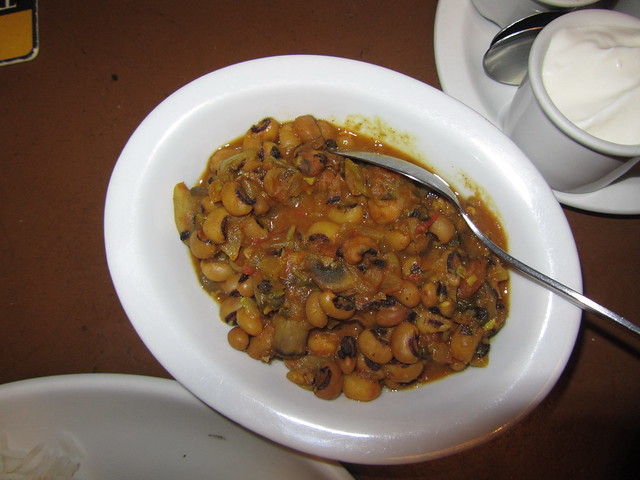
But the best meal we had there were their curries. Even though we had a few curries in London, the two curries here were so much better, and fresher, than any curry we had in our entire trip. I chose the black-eyed pea dahl which was full of flavour.

Black bean dal at the North Inn

Hubby chose a beef vindaloo which was out of this world.

Beef curry at the North Inn

It’s wonderful to find these little places to eat in England. It certainly made the frigid March weather a little more bearable. That said, we were quite happy to leave it and discover Greece…

Eat for England! – Part 2

Out of London, the choices were not so varied, but the quality of good old fashioned British cooking and local ingredients were hard to beat. In Chatsworth, I had a Ploughman’s lunch that was of the highest order, complete with a pork pie, homemade bread, assorted cheeses and pickles and salad that was mostly sourced from the estate itself.

Ploughmans lunch at Chatsworth House

The bed and breakfast places that we stayed at were a constant source of good food. In Cornwall, our B&B also served afternoon tea. I had a Cornish tea with scones, jam and the (in)famous clotted cream.

Cornish Cream Tea

In Derbyshire, the owner of our B&B had hand-caught the trout that we ate for dinner in the Derwent River, conveniently located across the road. Needless to say, the trout was succulent and awesome.

Baked Rainbow trout at the Cables B and B

Eat for England! – Part 1

Before I move on to Greece, I need to post once more about England, and it’s about quite an important aspect of travel – food!

I was actually pleasantly surprised with the food all throughout the country. It’s certainly an improvement from when I was last in the country, some 13 years ago. It looks like the English have finally embraced Asian food of all kinds, not just from the sub-continent. There were Japansese, Vietnamese and even Korean restaurants in central London. My favourite dishes were from restaurants in the East End.

Kid goat at Moro Restaurant

Kid goat with roasted beetroot, rainbow chard and lentils from Moro in Islington. The combination of spices and top ingredients was heavenly.

Braised Ox Cheeks at St John

Braised ox cheeks at St John in Clerkenwell. This must be one of the first restaurants to embrace nose to tail cooking. The tenderness of the ox cheeks has to be eaten to be believed.

This was just two of many great dishes we ate in London. Next, food in the countryside.

Canterbury – Part 5

Outside the cathedral were the old cloisters.

Canterbury Cathedral

Much of it was disused after the Dissolution of Monasteries by Henry VIII, but one can still imagine robed monks, priests and bishops shuffling down these paths and catacombs.

Canterbury Cathedral

Canterbury Cathedral

Well, that ends our trip around England. But it’s definitely not the end of our journey. Oh no, if you can believe it, we’ve only just started. Next up, a country I touched on briefly during my visit to the British Museum – Greece.

Canterbury – Part 4

The cathedral has its darker side. In the basement lies this altar – the place where St Thomas Becket died.

Canterbury Cathedral

Thomas Becket was Archbishop of Canterbury in the 12th Century, in the time of King Henry II. He and Henry were friends (Becket was Henry’s chancellor at one stage), but fell out over the rights and privileges of the church versus that of the monarchy. Henry wanted the church to live by the rules of the land, but Becket maintained that the church and its clerics should be judged by their own rules (strangely topical given the revelations this week about how the contemporary Catholic church handled its crimes and criminals).

The controversy lasted for a good part of a decade, and by the time Becket had excommunicated many of his advisers Henry had had enough and said so to his court. This inspired four of Henry’s supporters to come to their king’s aid and assassinate the archibishop while he said his prayers.

So Henry got rid of the ‘rogue’ Becket and was able to reassert his position. Becket meanwhile became a martyr of the church and was made saint within two years of his death. His shrine in the cathedral became the main attraction for pilgrims over the centuries. So in my humble opinion, in the end it was even-stevens between the two.

Canterbury – Part 3

It was Easter Saturday when we visited, so there were reminders of the Paschal season all around the cathedral.

Canterbury Cathedral

We walked inside and was greeted by such a sight. The nave was bigger and higher than any church in London – the church did really seem to go forever. And it was was heated too. One wonders about their heating bills. I think most of the entrance fee would go towards this.

Canterbury Cathedral

The main altar and seats were rather modern, yet organic, which I quite liked. None of your jewelled thrones here.

Canterbury Cathedral

But the bell tower was something else. It’s gothic style at its best.

Canterbury Cathedral

Canterbury – Part 2

But our prime destination for the day was the great Canterbury Cathedral, which is right in the middle of the old town. The entrance is via this stunning gate.

Canterbury Cathedral

The central figure looks rather scary. Even though it looks like he’s been there forever, it’s only a recent add-in and a mere twenty years old.

Canterbury Cathedral

Once through the gate, we were struck by the size and majesty of this gothic church. It’s certainly worthy as the central place of worship in the Anglican Church.

Canterbury Cathedral

We’ll have a better look around in my next post.

Canterbury – Part 1

Not Canterbury in New South Wales, or even Victoria. It’s the original Canterbury in Kent, east of London. To get there nowadays takes a mere hour due to the Channel Tunnel line. Add to that being the Easter long weekend, it’s no wonder that the town was filled to the brim.

Canterbury

The town is the seat of the Archibishop of Canterbury, the leading cleric of the Church of England, and has been the prime pilgrimage spot in England since the 7th Century. It’s no wonder that so much of the city is well-preserved, like the main gate, which has existed since Roman times, although the current version is medieval.

Canterbury

Being a pilgrimage, and now a tourist town, there were plenty of restaurants, accommodation and souvenir shops around.

Canterbury

But I liked how the old town is still full of half-timbered buildings that houses all the shops, even somewhere as pedestrian as Starbucks.

Canterbury