The views on Santorini become even more enchanting as the sun goes down.

The cliffs and the white-washed houses take on a golden glow.

It’s certainly a great time to enjoy a drink or three on a balcony.


The views on Santorini become even more enchanting as the sun goes down.
The cliffs and the white-washed houses take on a golden glow.
It’s certainly a great time to enjoy a drink or three on a balcony.
We still had a long way to go yet – past that church with the blue dome at the top of the hill.

On the way, we passed a few other churches. There was certainly an abundance of them on this part of the island.


At least because of tourism, much of the old architecture has been preserved, like this old windmill.

There was of course some more jaw-dropping views of the caldera.

And after two hours of walking, we finally reached the end of the road. What a view it was.

I would have loved to stay here for a week, but much of the accommodation at the end of the road was still closed.

And now for the journey back down. With views like this, it wasn’t much of a hardship.

Let’s take a walk. As I mentioned before, the main villages in Santorini are located along the cliff tops. They must have been distinct villages at one stage, but these days they have merged into one long village. We start off at the quarry, opposite our hotel. The town of Fira looms large.

A wander down the back alleys took us past a church, where the bell-ringer was getting a morning work-out.


The hotels and pensions were stacked way down the cliff side in this area. Even though the view would be great, I wouldn’t fancy a 100 stair walk everytime I wanted something.

Looking up, we had a long, long way to go yet.

There was option to take the easy way up, if you’re coming in from the bottom of the cliff off the ships. But we came by plane and so came by taxi.


Soon we were able to stop at a cafe, and admire the view.

But don’t go away as we’re only halfway through the walk!
Hubby was certainly fascinated by the geological aspects of the Santorini eruption, and certainly the signs of a massive eruption was all around, if you know what to look for. To begin with, the soil on the island was all made of volcanic ash. In fact the ash layer was perhaps 50 metres thick. You can see it in this quarry. All those layers under the buildings are all ash.

The volcano before the eruption must have been very big. Hubby says it would have looked like any other volcano cone, perhaps like the shape of Mount Fuji, but bigger. You can get a taste of the scale of the volcano from various high points on the island.

We could see the shape of the caldera clearly curve around from the village of Pyrgos, which we will visit later.


Whichever way you look at the island, Santorini is certainly impressive.
We’ve finally made it to our final destination, in Greece at least – the island of Santorini. Santorini is what Greek holiday dreams are made of – stunning location, generally good weather, and large selection of accommodation and activities. That also meant that there was bound to be crowds all year round. We certainly weren’t sure of what we would find in April, but we were pleasantly surprised.
Our hotel was a pretty plush affair, and postcard-perfect, if it wasn’t for the 30km/h winds and mid-teen temperatures that greeted our arrival.
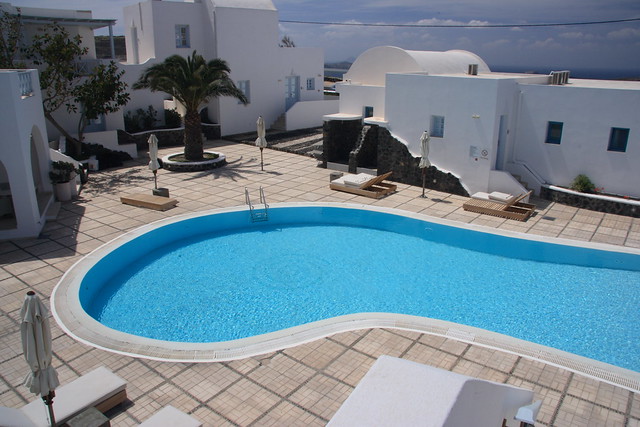
We didn’t have a ‘caldera view’ despite the plushness, but a quick walk across the road remedied that.

Santorini is of course the main island of what was once the rim of a super volcano. The volcano infamously imploded upon itself around 4000 years ago, wiping out the Minoan civilisation, and creating the caldera (a flooded volcano) that we see today. Since then a mini volcano has started growing in the middle, so Santorini isn’t quite dormant yet. An active volcano doesn’t seem to put off the cruise ships – it’s the favourite destination of many Mediterranean cruises.
The towns on the island are mainly perched high upon the rim. We stayed near the main town of Fira where the houses were built staggered down the cliff-side. That made for a lot of stair-walking.

We’ll be exploring the town and its surrounds in the next few posts.
Food on Thassos is nice and fresh. There were of course a lot of vegetables as expected, particularly salads. Because the town has a lot of Eastern European visitors, the salads here seem to have an Eastern European twist – cabbages and potatoes featured widely. And since the island grows some lovely olives, they also featured too.

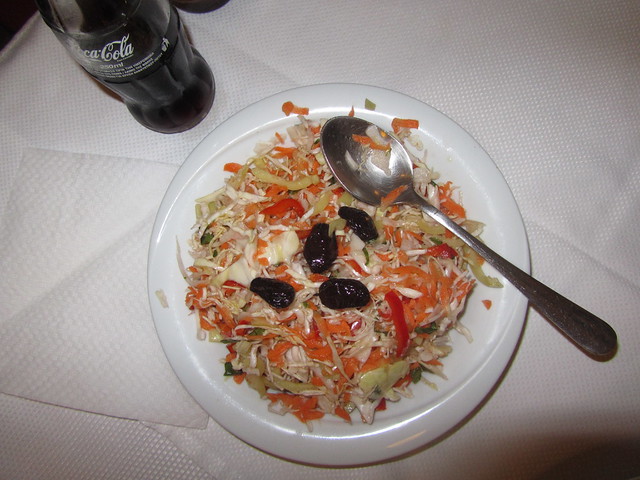

There were the usual grilled meats – although we did come across some lamb chops here, which we’ve ironically not much thus far.


And being by the sea, we came across some lovely seafood – prawns in a tomato sauce and fried baby calamari (the best). There were also grilled small fish available, but since I didn’t particularly look forward to picking over the bones, I declined.


The great thing about eating on Thassos (and that goes for all of Thrace) is that the prices are half of that of Athens! We’d be able to get a full meal for three people (including drinks) for less than 40 Euros. That’s certainly a bargain.
We headed for the south coast of island of Thassos, to the town of Potos. It’s about an 80km drive from where the ferry landed in the north. Like a lot of Greek islands, Thassos is very mountainous in the middle. In fact, the highest peak is over 1,200 metres – taller than the Blue Mountains.

But I was looking forward to seeing the Aegean Sea, and luckily I got a nice day to enjoy the seaside.

Even though Potos is a resort town, it still has a few fishing boats moored.

But most of the boats were recreational.

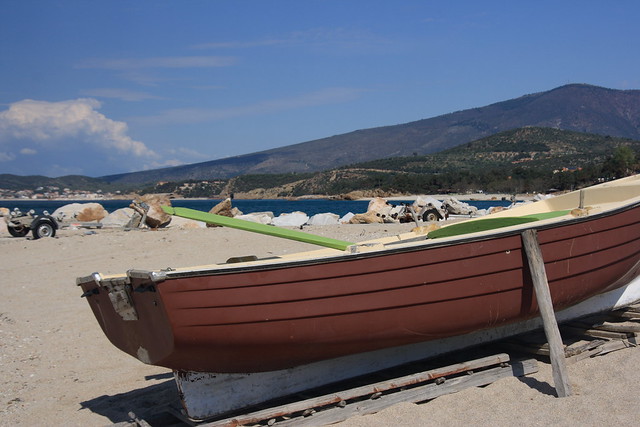
Potos was very quiet in April. It felt like we were the only tourists around. It would be different if we visited a few weeks later, when Bulgarian and Romanian holiday-makers head for their Easter break.

And I’m always fascinated by the ‘Aussie’ bar. They are getting to be as ubiquitous as the Irish pub.

We are heading for the northern Aegean island of Thassos, about 10km offshore. To get there, we need to take a ferry from the small port of Keramoti.

Keramoti seemed a sleepy enough place in Spring, although the locals told us that all hell breaks loose in the summer when it is filled with Eastern European tourists heading for Thassos.


A storm was brewing as we waited for the ferry. Lucky for me, the crossing was not too bad.

I thought that the Pomaks had an ancient way of life, but there was a lot of history to be had in Thrace. There were of course some remnants of Ancient Greece, like this amphitheatre in the coastal region of Maronia.

But the Ancient Greeks weren’t the first to live in the region. Oh no, human history in this area went way back to the stone age. These first peoples weren’t Greeks but Thracians who came before them. Like in Stonehenge, these people worked with stone. We didn’t see any stone circles as such, but one look at the landscape would tell you why the ancient Thracians found Maronia so special.


It looked as if a giant had just trampled through a mountain and tossed around a few boulders.


It also had olive groves that seemed to have been planted by the Ancient Greeks themselves.


We didn’t see another soul while we were there. Unfortunately some locals had started grazing their cattle there – a big shame since it meant that the area would be greatly damaged. But that’s the way it goes in Greece. If you know some one who knows some one and you can strike a deal between you all, then the rule book (if there was one in the first place) goes out the window.

We weren’t only eating vegetables – that certainly won’t sustain you up in the mountains. We had our share of non-veg dishes too. This sausage was a bit like a chorizo, but perhaps more Turkish influenced.

The chicken souvlaki was marinated with a mix of oregano and thyme – typical of Greece.

This fried hard cheese I think tastes like haloumi, but harder.

And of course, big chunks of goats milk feta.

We had plenty of ‘schnitzels’ too. This one is made from pork with a mushroom and cream sauce.

And the favourite lunch-time dish of herders, lamb chop stew with risoni.

After all that eating, there really wasn’t any room for dessert. We only managed it once. Being in Greece, they were super-sweet.

 Static and Silence