We took a drive on the quiet country roads around Canowindra.
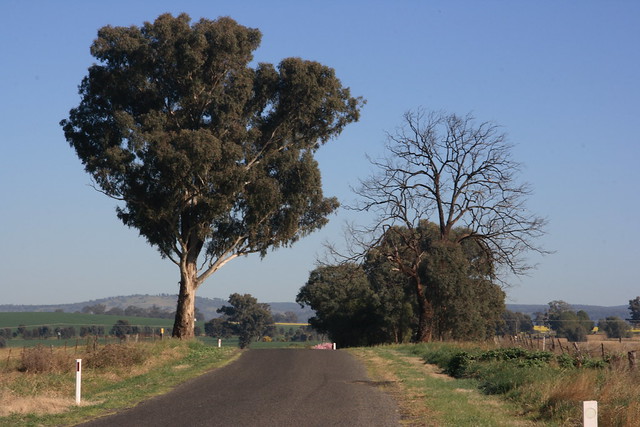
It was a magnificent spring day, and the whole country was alive with canola flowers,

Or cherry blossoms.
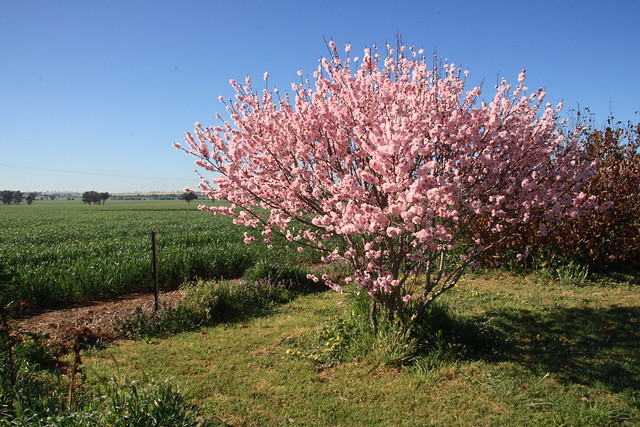
Sometimes there was both.


We took a drive on the quiet country roads around Canowindra.
It was a magnificent spring day, and the whole country was alive with canola flowers,
Or cherry blossoms.
Sometimes there was both.
And of course, there were the pubs of Canowindra.
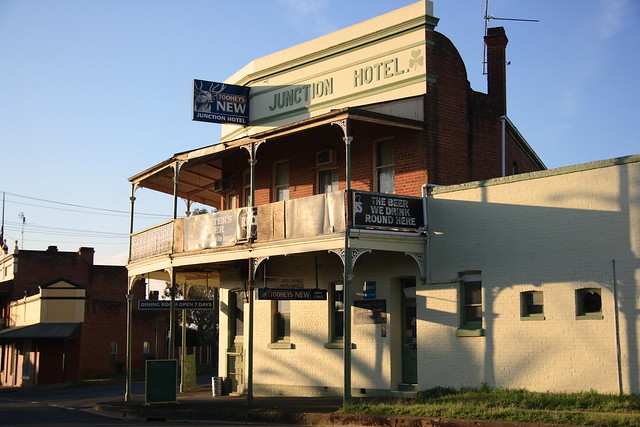
The town was big enough to have more than one.

In fact, there were more than just these three! The last one is for Joan, who likes ‘collecting’ Royal hotels, although I noticed she has this one already.
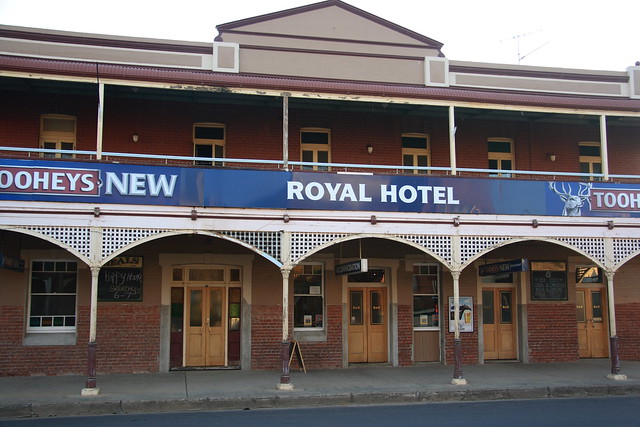
We entered the old commercial street, and it was a bit like going into a wild west movie set!

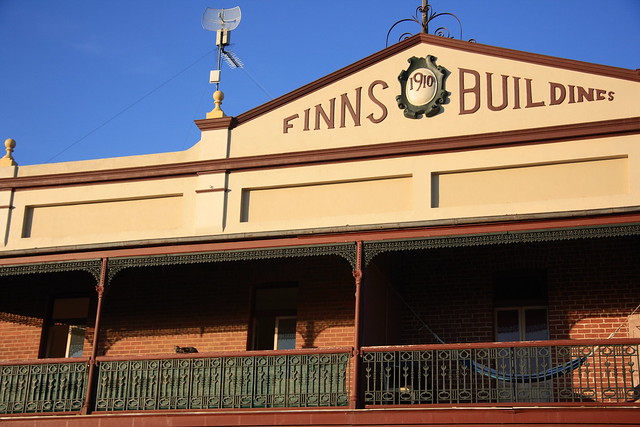
There were some wonderful buildings, most of which was in commercial use.

This one had a resident cat.
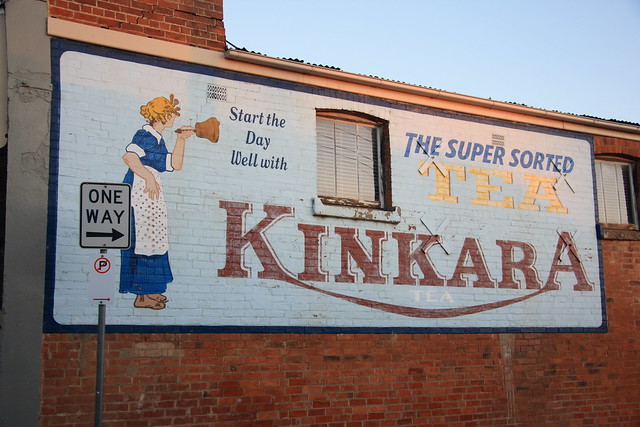
There was even an old mural.
We travelled south-west of Bathurst to our chief destination for the weekend, the sleepy town of Canowindra. After settling into our motel, we wandered around the main street.
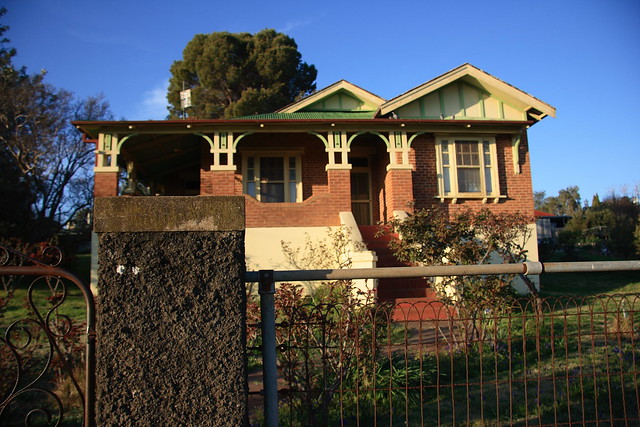
The residential houses were Edwardian, I think, of the same vintage as those around the suburbs of Ashfield, Summer Hill and Croydon in Sydney’s inner-west.
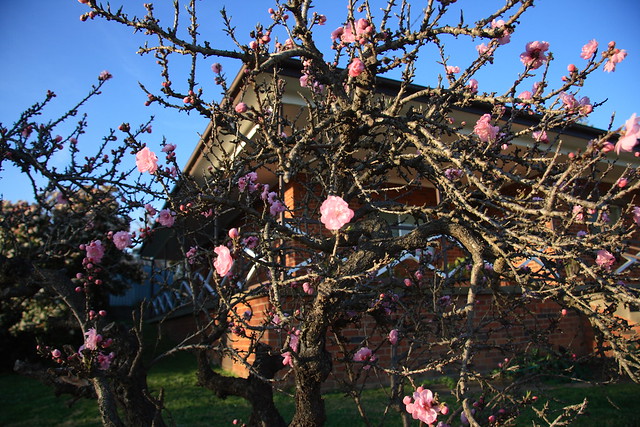
A few had some lovely blooms on display.
Soon we came to the shopping precinct. With some lovely architecture, I wasn’t surprised to find out that it’s been used as a film set recently.

However, the streets were very quiet, even for a Saturday evening. We found out after we got home that there had been a memorial for one of the victims of the Rozelle fire, who came from here. Everybody is affected when something happens in a town of this size (Canowindra’s population is around 1,500).
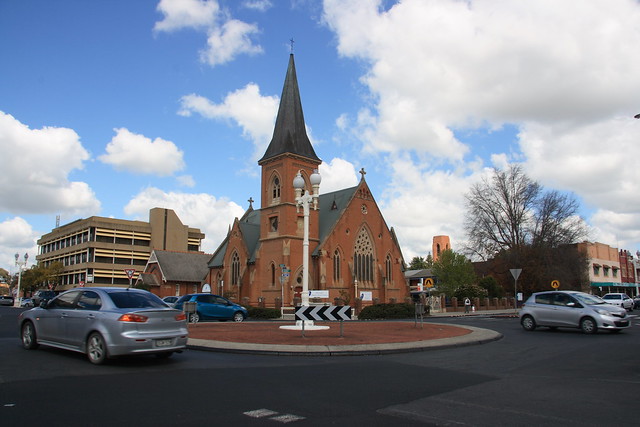
Next stop was the busy city of Bathurst. Its roundabout was in full-swing as it was Saturday lunchtime.
The Bathurst region was one of the first areas in Australia to be hit by the gold rush. This plaque marked the beginnings of it all.

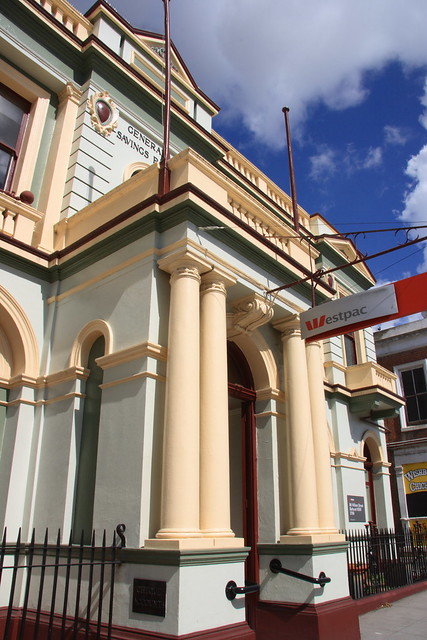
The old Bank of New South Wales has stood by it all, good and bad.
The country around Dripstone is pretty typical of Central NSW – pasture land with gently rolling hills and patches of bush. Dripstone, as far as I could tell, was just a cluster of small acre properties on a karst (cave country) hill. Hence the name, I suppose.

The grass was long from the summer rains.

It looked enchanting in the late autumn afternoon light, even if it was really hard to walk through for a short, city slicker like me.

I couldn’t help myself, I was trigger happy.


And as I took these shots, the afternoon XPT cruised by in the valley below, back to Sydney. Back home.

Well, that’s the end of our adventure in Central NSW. But don’t despair, I have plenty of places and things to show you yet.
Later in the day we travelled 15 minutes away to Dripstone, to look for more fossils, this time to take home.

We had to look a bit harder among the tall grass for them, but we did find a few things in the end. Like little stromatolites (they are small here, the little circular things).

Corals in different shapes than those at Wellington Caves.

And another block rich in crinoid stems.

There were also caves in the area, although the entrances are so small that no one was willing to climb in.
The limestone around Wellington is Devonian in age, around 390 million years ago. Back then, the area was still under water – a shallow sea. Dinosaurs weren’t to appear for at least another 150 million years. Plants were only starting to grow on land, and were probably very strange-looking. The only land animals were arthropods (insects, crustaceans, spiders) and lung fish with legs.
Most plant and animal life lived in the sea, and in the limestone, we saw a good cross-section of what was around in the ocean.
There were snails and other marine gastropods.

Giant stromatolites formed by micro-organisms (closely related to blue green algae). You can see the layers of sediment they formed.
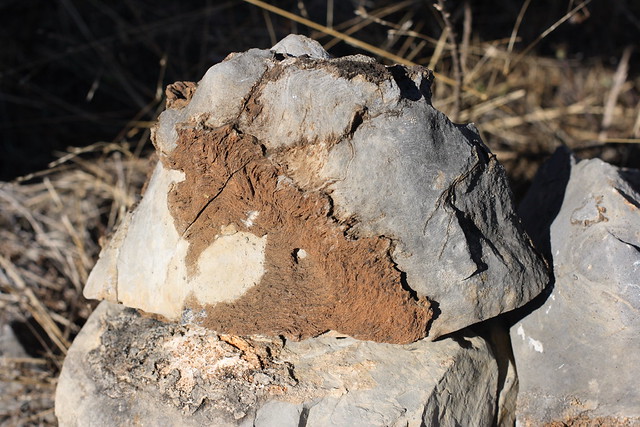
Block of crinoid stems – remnants of ancient sea lilies.

But mostly, we saw lots and lots of coral. Yes, the ancestors of the coral that form the Great Barrier Reef.

They were literally all over the rocks in places.


The only thing we didn’t see (although there were plenty out there at the time) was fish. I guess I have to go to Canowindra one day to see Devonian fish in abundance.
The proportions of the cave were quite impressive. The stalactites were large and heavy overhead, meaning that they must have formed over hundreds of thousands of years.

There were other interesting formations in the cave that you don’t usually see. We saw lots of evidence of folding.

You have to imagine that these layers were once flat, and that the earth’s forces over time had folded them over each other like pancakes.
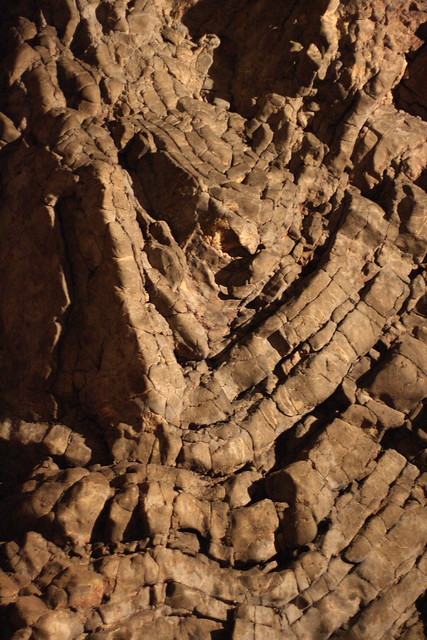
I think it’s as impressive a sight as anything in the cave.
I’m back from holidays, and starting where I left off, at Wellington Caves.
We are going into the caves proper for the next couple of posts. Cathedral Cave is the main attraction of the cave system. It is actually only made up of one room, plus a well and an ‘attic’ but the room itself is very impressive.

Look at all the flow stone at the back, like organ pipes. The ceiling is also very high, and so the acoustics are good. Not surprisingly, the space is available for functions – concerts, weddings, etc etc.
 Static and Silence
