All posts by Sandra Graham

I am an artist and blogger living in Sydney, Australia. I am interested in Australian landscapes and lost suburbia, capturing them in photographs, paintings, prints and mixed media. @s_graham_art

Inner City Catch-Up Lunch

What a way to catch up with friends than to enjoy a leisurely 3 course lunch! I met up with N and F pre-Christmas at the Devonshire Restaurant in Surry Hills, where their Prix Fixe Friday lunch was too good to be missed. The menu changed weekly, but we weren’t too pertubed about what we got as we knew it was all going to be very good indeed. We weren’t wrong.

For entree was roasted pork belly croustillant, spiced apple relish, shaved fennel and radish. It was a spring roll that had been well and truly pimped, but with the salad and relish was still light and fresh.

Roasted pork belly croustillant, spiced apple relish, shaved fennel and radish

The main was the magnificent seared Ora king salmon, fried calamari, squid ink, orange and chive dressing. With a crispy skin, more-ish sauce and dressing, all refreshed by the oranges (a citrus that you don’t often think of when accompanying fish), it tasted as good as it looked.

Seared Ora King Salmon, fried calamari, squid ink, orange and chive dressing

The sides of broccolini and twice-cooked potatoes were also amazing. How did they get the potatoes so crispy, I wonder?

Brocollini and walnuts

Twice cooked King Edward potatoes

We really didn’t have any room left after that effort, but still we managed to fit in a delectable sticky pear pudding, toasted coconut milk sorbet and toffee sauce. The pudding was surprisingly light, and the sorbet creamy without being too rich. A perfect end to the meal.

Sticky pear pudding, toasted coconut milk sorbet and toffee sauce

Waitomo

One place we visited that had nothing to do with volcanoes was Waitomo Caves. The caves were set in dense rainforest, and is famous for their glow worms. I have been to some of these caves before but since then they have opened up some new caves – we were able to visit three of them.

Waitomo Caves

Waitomo Caves

They weren’t the biggest caves I had ever seen, but they did have some lovely details.

Waitomo Caves

Waitomo Caves

Waitomo Caves

One of them you descend into by a giant corkscrew ramp, and had suspended walkways to keep you above the wet floor. Now that’s engineering.

Waitomo Caves

Waitomo Caves

The Kiwis are good like that, very creative, out of the box thinkers, and you see evidence of it everywhere. Sorry to say, but often Aussies seem like square pegs in comparison.

Waitomo Caves

Well, we’ve come to the end of our geological tour of NZ, and all the travel posts too. I’ll be posting about things much closer to home from now on, which isn’t all bad, because 4 months of travelling was very exhausting.

Taupo

Down the road from Rotorua in Taupo, they make use of the geothermal energy by building powerstations.

Taupo Geothermal Power Station

The raging Waikato river (shown below at Huka Falls), means that there are also hydroelectric power stations too.

Huka Falls

Huka Falls

One needs only to look at the vastness of Lake Taupo, the result of a supervolcano eruption, and whose vast caldera is still active underground, to know that there’s certainly energy available, but if that volcano was to erupt again, then we’d all be in big trouble.

Lake Taupo

Lake Taupo

Rotorua – Part 3

But there are advantages to living in a geothermal area. One is that you can have free hot water. The city has been using the underground hot water sources since Maori times. The Maoris bathed and cooked their food in the hot water (at different temperatures of course). The Europeans followed suit, and opened a spa resort. No, health spas aren’t a modern invention – the Victorians were addicted to them. Rotorua has preserved its oldest, set in this mock Tudor mansion.

Government Gardens

It is now a museum and not a spa resort, but inside you do get an idea of how grand it all was. People came from all over the world to experience its ‘cures’.

Rotorua Museum

The treatments offered back in the day were pretty extreme. Swims, soaks and showers at various temperatures, hot towel wraps, massages, electricution and x-rays (to stimulate the blood), and literal mud baths in the dank basement!

Rotorua Museum

Added to that a meagre diet, drinking disgusting mineral water, and taking a walk by the lake, and you’d be good as new (or so they say) whatever your ailment. Personally, I’d stick to a simply massage and spa.

Rotorua – Part 2

Aside from geysers, there were plenty of geothermal attractions all over the place. In some places you really did need to watch where you were going lest you fall into a pool of hot, acidic mud.

Wai-o-tapu

Hell's Gate

The mineral rich pools came in all shades, no food colouring involved.

Wai-o-tapu

Wai-o-tapu

Wai-o-tapu

In other places, the landscape created by all of this turmoil was very pretty.

Hell's Gate

Waimangu

There were plenty of stories told by our various guides, particularly from the 19th Century when a local volcano, Mount Tarawera, erupted, destroying much of the area and killing many people. It could happen again, and soon. Despite this, Rotorua is one of the North Island’s bigger towns being a centre for forestry, energy and tourism. It goes to show that the locals must be hardy types.

Hell's Gate

Rotorua – Part 1

Next we explored the geothermal wonderland that is Rotorua. Seeing a geyser come into life is a good introduction of what’s underneath the city. The Lady Knox Geyser erupts every day at 10.15am, with a bit of human intervention.

Lady Knox Geyser

From then on it took a couple of minutes to bubble up.

Lady Knox Geyser

Lady Knox Geyser

And then burst into life.

Lady Knox Geyser

Lady Knox Geyser

Not a bad start to the tour. Certainly don’t see anything like this in Australia.

White Island – Part 3

We turned back from the crater to walk back to the beach. The blue sky and sea made a dramatic contrast to the crater.

Day trip to White Island

Day trip to White Island

Near the beach, we visited the remnants of the old sulphur mine. At the turn of the 20th Century, some very hardy souls tried to mine the deposits of yellow sulphur. Sulphur was used in medicines, as sterilisation, in match heads, and in fertiliser, so they thought there was a buck to be made.

Day trip to White Island

Day trip to White Island

Living on a volcano had its downsides. Food and water had to be brought to the island, however since the Bay of Plenty was frequently rough, supplies weren’t guaranteed. The air quality (as we found out) wasn’t great, and the sulphuric acid ate away at everything. But most crucially, a hundred years ago they didn’t have seismic monitoring and so when part of the rim collapsed in 1914 creating a lahar (a mudflow made up of volcanic material and water) the 10 workers on the island didn’t have a hope. The only survivor was the camp cat, Peter, which was found a few days later. He was appropriately renamed ‘Peter the Great’ and became a local celebrity.

Day trip to White Island

Day trip to White Island

They had another go at mining a few years later, but the amount and quality of sulphur wasn’t great and so mining was abandoned; the buildings and equipment left to corrode in the sulphuric fumes.

Day trip to White Island

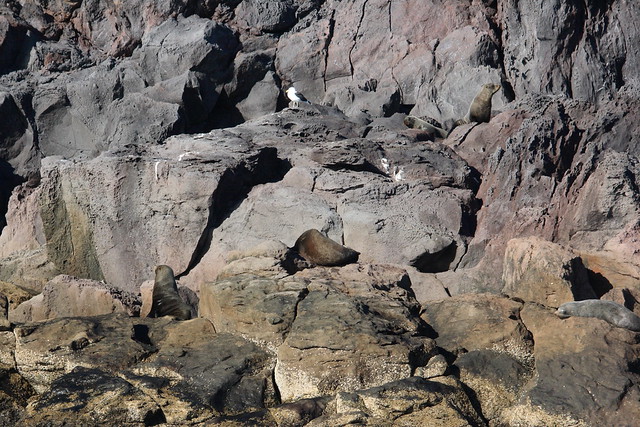
We returned to the boat, and on the way back to Whakatane passed by a New Zealand fur seal colony nearby. At least these guys can get away quick smart if the volcano gets twitchy.

Day trip to White Island

The boat sped off back to land, and soon the volcano was once again steaming away in the distance. This was one adventure we won’t forget in a hurry.

Day trip to White Island

White Island – Part 2

We left the relative comfort of the boat and stepped on to a moonscape. This was the earth at its most raw, how it must have looked when it was first born.

Day trip to White Island

Day trip to White Island

Day trip to White Island

All around us were piles of rocks (some of startling hues due to its mineral content), steaming vents, and bubbling mud pools. We were given gas masks as the sulphire dioxide (that stinky egg smell) was sometimes overpowering. We really had to follow our guides carefully as none of us wanted to drown in a pool of hot acid.

Day trip to White Island

Day trip to White Island

Day trip to White Island

The most impressive site was the steaming vent, or series of vents. Even though the steam was caused by seawater pouring into the hot crater and something more noxious, it was still frightening. It was like peering into the depths of hell.

Day trip to White Island

Day trip to White Island

White Island – Part 1

Our visit to White Island was certainly the highlight of the tour. White Island is an active volcano 50km off the coast, in the middle of the Bay of Plenty. There’s not that many places on earth where you can step into the crater of a live volcano so everyone on the tour was excited.

It was an early, pre-dawn start, with breakfast at 5.15am so we could reach the Bay of Plenty town of Whakatane, our departure point. The sun was just rising when the boat passed the sandbar.

Day trip to White Island

Day trip to White Island

The coast was soon behind us as we cruised into the middle of the bay.

Day trip to White Island

Day trip to White Island

It was a bit chilly on deck, but being very prone to seasickness, I’d rather be there than indoors. Luckily the weather was good and the water was quite calm.

Day trip to White Island

We first caught sight of the island about an hour or so into the journey. And the volcano was steaming!

Day trip to White Island

Day trip to White Island

Day trip to White Island

We arrived at the hour-and-a-half mark. With some trepidation, we boarded the rubber zodiacs and approached the island.

Day trip to White Island

What did we find?