Tag Archives: central nsw

Paleontology – Sorting It All Out

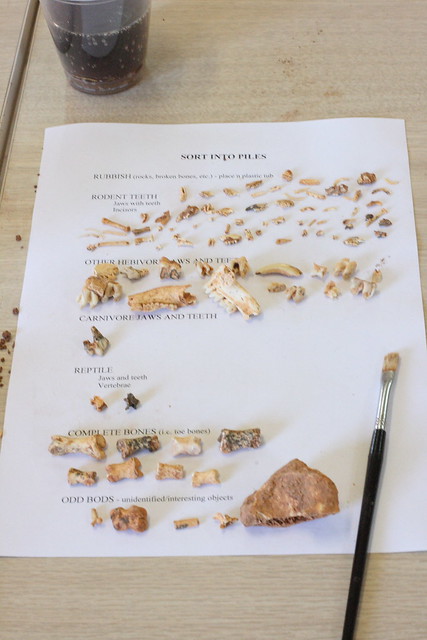
Once you gathered together your pile of fossils, how do you know what you have? These students had a guide to what the bones and teeth of various animals looked like to help them.

Sorting

And it’s also good to have a resident paleontologist nearby to help you identify things. These scientists have been studying bones and teeth of animals for over 30 years, so they know what they are talking about.

Sorting

The students sorted their finds neatly into groups.
Sorting

Some of them found some interesting things…

Sorting

All this sorting helped the paleontologists catalogue what was in the pile, which told us the kinds of animals alive back then.

Looking at the white board at the end of the session, there were a lot of different finds that day.

Sorting

It goes to show how diverse the fauna was back then – even more so that now, in a way.

That comes to the end of our walk through the Pleistocene age of one million years ago. I’ll be on a blog break for the next two weeks, and will be back with some Devonian fossils from around 400 million years ago!

Paleontology – Extraction

It was interesting to see paleontologists (albeit students) in action. How do you extract the fossils from this?

Wellington Caves Museum

When the mine was redug out in the 1990’s, it was already in dirt form, not in rock form. But how to sort the fossils from the dirt?

First you put a pile of ‘dirt’ in a sifter (the metal box).

Washing and sorting

Then you give it a good wash in the trough.

Washing and sorting

You lay out what’s left in the sun to dry.

Washing and sorting

And then collect it, ready for sorting.

Sorting

Pleistocene Reptiles

Outside, we saw the cave where Mitchell and Rankin found the first diprotodon bones.

Mitchell Cave

But as more bones were discovered, they found bones of creatues that were distinctly reptilian.

There were fossils from a giant lizard, which they named megalania. They were much bigger than present day Komodo dragons, at almost 5 metres in length. We saw a full-size replica in the bush.

Megalania

But more interesting I think were the Wonambi – giant snakes. Here is a replica at the bottom of a sink hole.

Wonambi

These snakes were estimated at 10 to 11 metres long. We saw some vertebrae that had been collected.

Sorting

Three vertabrae just fitted into a drawer, and if you think of how a human back bone looks in comparison to its size, then it’s obvious that this snake was very big.

Sorting

Perhaps this was what the early Aboriginals saw when they first came to Australia? Perhaps this was their Rainbow Serpent?

Palorchestes and Other Marsupials

In fact, there were lots of interesting marsupials around a million years ago, that are now extinct.

Phosphate Mine

Later, we were shown lots of evidence of them. Here is an assortment of different kangaroo jaws.

Sorting

Teeth from a giant wombat.

Sorting

Even the front tooth from a palorchestes – a marsupial tapir – that we found on the ground.

Washing and sorting

Of course, the marsupials weren’t on their own. There were other interesting creatures around at the time too.

Thylacoleo – Hunter Extraordinaire

The diprotodon might have been big, but by most accounts it was a gentle giant. There were however carnivore marsupials around at the time too, and ones that were bigger than the Devils. The most ferocious was a species called thylacoleo – the marsupial lion.

Phosphate Mine

We saw a replica of a full skeleton, and there were bits and pieces also on display. The animal is likened more to a leopard than a lion, in that it was of similar size, had a powerful jaw and teeth like sheers, and long retractable claws to slash its prey, and scarily, climb trees. It would be the most ferocious drop bear you’d ever see. They were so effective in their hunting that they would prey on the hapless diprotodon and other large herbivores.

Glad this guy isn’t around anymore!

Into the Mine – Part 5

I don’t think the early colonials knew what they were getting themselves into when they found the first big bones in Wellington Caves. This is a replica of one creature they found.

Phosphate Mine

It’s the size of a hippo, but there wasn’t anything remotely as big in Australia these days. So what could it be?

Phosphate Mine

They found a diprotodon. It’s a wombat-like herbivore, a marsupial, but one that was between the size of a hippo and an elephant. They were around one million years ago, when the area around Wellington Caves was much wetter, and there was much more vegetation to eat. They died out perhaps 25 to 50 thousand years ago, although scientists are still arguing why (climate change?).

Imagine having one of those roaming the back paddock.

Into the Mine – Part 4

Phosphate wasn’t the only thing the miners found.

Phosphate Mine

The deeper they went, the more fossils they found.

Phosphate Mine

At one place, there was a wall full of bones and teeth.

Phosphate Mine

Over the years, paleontologists have been digging up and studying the fossils found in the mine. Some even ended up in Germany.

Phosphate Mine

But how had the animals got there?

Phosphate Mine

Scientists think it might be one of two ways. Remember the bats, the ones who produced all the poo? These bones might be the remnants of their kills. That’s why there were a lot of small animals there – rodents, snakes, bandicoots, and other small marsupials. The second way was that they fell into the caves through sink holes and couldn’t get back out.

The first explanation covers the shards on the walls. The second covers the bigger things they found. We’ll see what they were next.

Into the Mine – Part 3

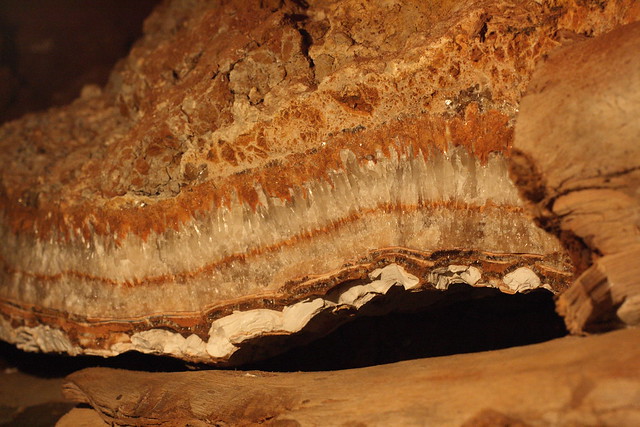
In the mine, you could see cross-sections of the limestone. How the minerals and water crystalised and formed calcite.

Phosphate Mine

But what was this phosphate they were digging out? The phosphate in this particular mine was formed from decomposed bat guano. That’s right, it’s very, very old bat poo from the Pleistocene (around 1 million years ago). You can see it here as the white bits.

Phosphate Mine

And here seaping into the rock crevices.

Phosphate Mine

Into the Mine – Part 1

The area south west of Wellington is well-known for its caves, even from early colonial times. It was already settled on by the time explorer Thomas Mitchell and his party ventured through in 1835 to trace the course of the Darling River. He was led by the local magistrate, George Rankin, to the caves, where they discovered some peculiar things. But more on that later.

The first thing you notice about the landscape is that it’s, well, lumpy. It’s what is called a karst landscape – the landscape of caves – and apart from the vegetation, it’s similar-looking everywhere you go on earth.

Phosphate Mine

But the interesting things aren’t on the surface, as you might have guessed, but in a WWI phosphate mine. So let’s go underground.

Phosphate Mine