Tag Archives: fossils

Riversleigh Cook’s Tour – Part 2

Mercifully, the tour was not all walking but was broken up by more of Mike’s anecdotes. At one site he found a mother and child diprotodon skeleton, just metres apart. When the local residents found out about the fossils and how they must have died together, they called it the Madonna and Child of Riversleigh. There were also stories told at previously worked sites like Camel Sputum (named by Henk, another palaeontologist, when he was in a particularly bad mood), and other curiously named localities, which together formed a loose history of the dig at Riversleigh. At each site, we saw bones peering out of the limestone, and proving that the ‘richness of the sites’ quoted in numerous articles wasn’t just hearsay.

Cook's Tour

We didn’t just learn about fossils though. The geologists were hard at work, seeking out flowstone – evidence of cave systems – that could be used to date the sites.

Cook's Tour

We saw more of the landscape – spinifex and acacia mostly.

Cook's Tour

And more of the trecherous limestone – I had to watch out for all those holes.

Cook's Tour

At lunch, our spider expert dug out a hairy native tarantula from under some Spinifex – in the name of research, of course – which became the prime attraction at the dinner table that evening.

Cook's Tour

All of this was very interesting, but for a person whose idea of exercise is a walk to the corner shop and back, it was also exhausting. I was ready for a big nanny nap. I might have an interest in palaeontology, but a field palaeontologist I was not meant to be.

Riversleigh Cook’s Tour – Part 1

After our visit to ‘D’ site, we drove back a mile along the main road before entering a gate into what looked to me like a wilderness. Then setting the four wheel drive into gear, we bashed through plains of grass seven feet tall, ducked in and out of dry creek beds, and swerved around termite nests. It might have only been a fifteen minute ride, but to a four wheel drive novice passenger like me, it seemed like an endless, bumpy drive into nowhere. It was only later that I found out that there was science in the madness – we had followed a well-known track, which due to a bumper wet season was grossly overgrown. Aside from the natural impediments, there were also man-made impediments. Some of the gates that we drove through were so complex to open that it seemed like you needed a degree to do so successfully. I quickly realised that the Gulf country was rougher than I thought.

Eventually, we stopped at a limestone ridge called the Bite-Centennial Gallery. This site produced the first big finds after ‘D’ site.

Cook's Tour

Mike, our guide for the day, was one of the key palaeontologists behind the Riversleigh finds. He has returned here at least once a year for the last 36 years. You’d say that he was fountain of knowledge about the area, but he was also an amusing story teller.

Cook's Tour

At Bite-Centennial Gallery, he began by recounting the disturbing story behind the name (involving a drunken, biting cattleman, a distressed geologist, and a decapitated yabby), before we walked up the ridge, which for me was when the fun started.

Cook's Tour

I have never been a rock wallaby. I like being in the outdoors, but I’m more comfortable with gentle strolls along established paths than bush bashing across the wilderness. And worse still, an ankle injury six months before had made me more hesitant on my feet than usual. You can guess that my first hour at the Gallery was not terribly fun. Grasses constantly pricked my short legs, their seeds covered my trousers and top, and the razor-sharp limestone cut my hands when I touched them. This certainly was not what I was expecting.

I learned my lesson quickly though. The next day, I wore gaiters to the field, and my shins certainly thanked me for it.

Riversleigh ‘D’ Site – Part 3

Riversleigh in the Miocene wasn’t anything like the dry plains that we see today. Think the Daintree region of Far North Queensland, where the rainforest meets the sea, and you get an idea what the landscape was like 25 million years ago. At Riversleigh, you can even see some fossilised wave action.

D Site

As for the fauna, it was rather different. Aside from the big bird, there were big snakes, wombats, kangaroos, and crocodiles. The long-nosed animal is my old friend, the palorchestes, related to the koala.

D Site

Riversleigh ‘D’ Site – Part 2

The Riversleigh fossil sites are now under the management of national parks. Unfortunately, some people seem to disregard the rule of not taking anything without permission, hence the sign below.

D Site

Apparently, people have lifted huge slabs, without remorse before. ‘D’ Site is the only site in Riversleigh open to the public, and the first that was worked on. Back in 1976, a group of palaeontologists from the Queensland Museum came out to explore a tip-off they got from one of their colleagues, who found lots of bone in the limestone years before, but didn’t bother to pursue it further because he thought bones in limestone were impossible to extract.

This was what he saw.

D Site

D Site

Luckily, the QM paleos were more persistent, and they discovered lots of bone peeking out from the rock. And discovered more creatures from Miocene Australia (around 25 million years ago).

D Site

These bones are the leg bone of a dromornis – a giant bird that weight over 500kg, with a lethally big beak. So big and lethal in fact that the scientists nicknamed it the ‘Demon Duck of Doom’ (it might be distantly related to modern ducks).

Here it is fighting with a crocodile!

D Site

Riversleigh ‘D’ Site – Part 1

Let’s talk a bit about Riversleigh and where it is. Riversleigh is named after the property that it was on, Riversleigh Station. It’s about 280km by road, north west of Mount Isa, smack bang in the Gulf Country.

The landscape didn’t make much of an impression for me at first. It’s generally flat, with ridges of hills every now and then.

D Site

What makes the hills around Riversleigh different is that they are made of limestone – yes, we’re in karst country once again. You can tell by the grey-ish boulders on top of the hill.

D Site

The limestone here isn’t as old as the limestone around Wellington, NSW. It is much, much younger, from 50 to 5 million years. It’s formed because of the spring waters that are particularly rich in calcium carbonate. It seems to bind to the bones of animals, and fossilise them very well indeed.

Next, ‘D’ site, and its fossils.

Devonian Sea Life – Part 2

Later in the day we travelled 15 minutes away to Dripstone, to look for more fossils, this time to take home.

Devonian fossils

We had to look a bit harder among the tall grass for them, but we did find a few things in the end. Like little stromatolites (they are small here, the little circular things).

Devonian fossils

Corals in different shapes than those at Wellington Caves.

Devonian fossils

And another block rich in crinoid stems.

Devonian fossils

There were also caves in the area, although the entrances are so small that no one was willing to climb in.

Devonian Sea Life – Part 1

The limestone around Wellington is Devonian in age, around 390 million years ago. Back then, the area was still under water – a shallow sea. Dinosaurs weren’t to appear for at least another 150 million years. Plants were only starting to grow on land, and were probably very strange-looking. The only land animals were arthropods (insects, crustaceans, spiders) and lung fish with legs.

Most plant and animal life lived in the sea, and in the limestone, we saw a good cross-section of what was around in the ocean.

There were snails and other marine gastropods.

Devonian fossils

Giant stromatolites formed by micro-organisms (closely related to blue green algae). You can see the layers of sediment they formed.

Devonian fossils

Block of crinoid stems – remnants of ancient sea lilies.

Devonian fossils

But mostly, we saw lots and lots of coral. Yes, the ancestors of the coral that form the Great Barrier Reef.

Devonian fossils

They were literally all over the rocks in places.

Devonian fossils

Devonian fossils

Devonian fossils

The only thing we didn’t see (although there were plenty out there at the time) was fish. I guess I have to go to Canowindra one day to see Devonian fish in abundance.

Paleontology – Sorting It All Out

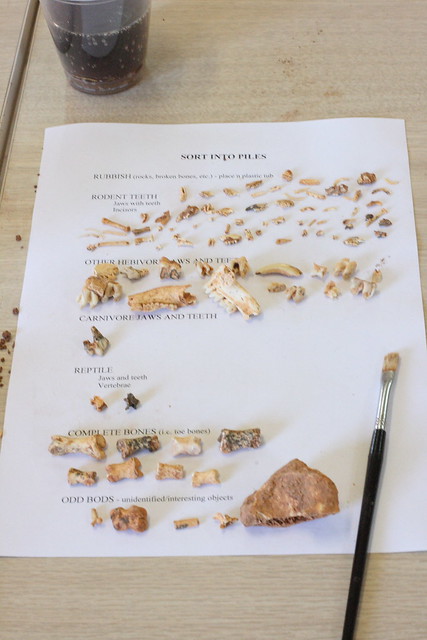
Once you gathered together your pile of fossils, how do you know what you have? These students had a guide to what the bones and teeth of various animals looked like to help them.

Sorting

And it’s also good to have a resident paleontologist nearby to help you identify things. These scientists have been studying bones and teeth of animals for over 30 years, so they know what they are talking about.

Sorting

The students sorted their finds neatly into groups.

Sorting

Some of them found some interesting things…

Sorting

All this sorting helped the paleontologists catalogue what was in the pile, which told us the kinds of animals alive back then.

Looking at the white board at the end of the session, there were a lot of different finds that day.

Sorting

It goes to show how diverse the fauna was back then – even more so that now, in a way.

That comes to the end of our walk through the Pleistocene age of one million years ago. I’ll be on a blog break for the next two weeks, and will be back with some Devonian fossils from around 400 million years ago!

Paleontology – Extraction

It was interesting to see paleontologists (albeit students) in action. How do you extract the fossils from this?

Wellington Caves Museum

When the mine was redug out in the 1990’s, it was already in dirt form, not in rock form. But how to sort the fossils from the dirt?

First you put a pile of ‘dirt’ in a sifter (the metal box).

Washing and sorting

Then you give it a good wash in the trough.

Washing and sorting

You lay out what’s left in the sun to dry.

Washing and sorting

And then collect it, ready for sorting.

Sorting