Tag Archives: geology

Riversleigh ‘D’ Site – Part 1

Let’s talk a bit about Riversleigh and where it is. Riversleigh is named after the property that it was on, Riversleigh Station. It’s about 280km by road, north west of Mount Isa, smack bang in the Gulf Country.

The landscape didn’t make much of an impression for me at first. It’s generally flat, with ridges of hills every now and then.

D Site

What makes the hills around Riversleigh different is that they are made of limestone – yes, we’re in karst country once again. You can tell by the grey-ish boulders on top of the hill.

D Site

The limestone here isn’t as old as the limestone around Wellington, NSW. It is much, much younger, from 50 to 5 million years. It’s formed because of the spring waters that are particularly rich in calcium carbonate. It seems to bind to the bones of animals, and fossilise them very well indeed.

Next, ‘D’ site, and its fossils.

Into the Mine – Part 5

I don’t think the early colonials knew what they were getting themselves into when they found the first big bones in Wellington Caves. This is a replica of one creature they found.

Phosphate Mine

It’s the size of a hippo, but there wasn’t anything remotely as big in Australia these days. So what could it be?

Phosphate Mine

They found a diprotodon. It’s a wombat-like herbivore, a marsupial, but one that was between the size of a hippo and an elephant. They were around one million years ago, when the area around Wellington Caves was much wetter, and there was much more vegetation to eat. They died out perhaps 25 to 50 thousand years ago, although scientists are still arguing why (climate change?).

Imagine having one of those roaming the back paddock.

Into the Mine – Part 3

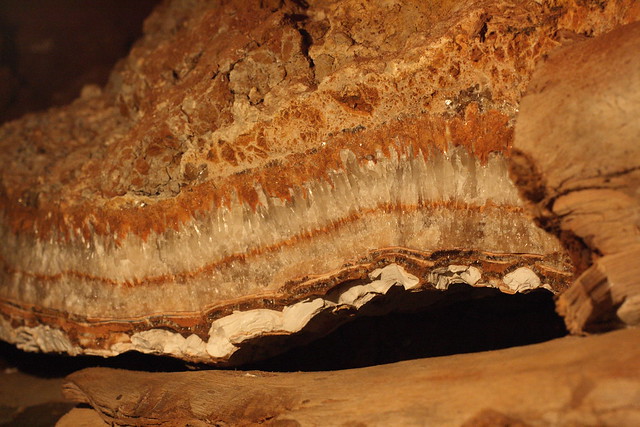
In the mine, you could see cross-sections of the limestone. How the minerals and water crystalised and formed calcite.

Phosphate Mine

But what was this phosphate they were digging out? The phosphate in this particular mine was formed from decomposed bat guano. That’s right, it’s very, very old bat poo from the Pleistocene (around 1 million years ago). You can see it here as the white bits.

Phosphate Mine

And here seaping into the rock crevices.

Phosphate Mine

Into the Mine – Part 1

The area south west of Wellington is well-known for its caves, even from early colonial times. It was already settled on by the time explorer Thomas Mitchell and his party ventured through in 1835 to trace the course of the Darling River. He was led by the local magistrate, George Rankin, to the caves, where they discovered some peculiar things. But more on that later.

The first thing you notice about the landscape is that it’s, well, lumpy. It’s what is called a karst landscape – the landscape of caves – and apart from the vegetation, it’s similar-looking everywhere you go on earth.

Phosphate Mine

But the interesting things aren’t on the surface, as you might have guessed, but in a WWI phosphate mine. So let’s go underground.

Phosphate Mine

Volcanoes and All That – Part 3

When the rock is blasted it forms nice columns, like these. The Giants Causeway in Northern Ireland have similar basalt columns, but in a seaside setting.

Kulnura Quarry

They are surprisingly heavy for their size, and are really hard rocks. These are crushed and used to make super concrete. This is the concrete for really big structures, like the World Square building and Anzac Bridge in Sydney.

We were allowed to take some home, and our columns sit happily in our garden at home.

Volcanoes and All That – Part 2

Looking at the walls of the quarry up close, you notice that the grooves lean this way and that, like someone has sketched it.

Kulnura Quarry

The grooves are formed when magma, coming out of the volcano, cools. Hubby the geologist says that the way the grooves lean point to the coolest point. Since the grooves on each layer point in different directions, it tells you that the volcano was active many, many times.

Kulnura Quarry

Close up, it looks very beautiful, like artwork.

Kulnura Quarry

The kids were pretty enthralled too.

Kulnura Quarry

Volcanoes and all that – Part 1

Looking at the landscape around Sydney now, it’s hard to believe that at one stage the area harboured some active volcanoes. The evidence may be hard to find now, but they are there.

Back to the geology excursion, the second half was a visit to Kulnura Quarry, in the tablelands of the Central Coast. The quarry produces basalt to be used in concrete and road base, and basalt (recalling all those high school science lessons) comes from volcanoes.

We could drive into the quarry. Here we are at the top of the hill.

Kulnura Quarry

We drive 160 metres down to the floor of the quarry.

Kulnura Quarry

And look back up to where we started.

Kulnura Quarry

That’s 50 years worth of digging – and they still haven’t hit the bottom. The manager said that there’s another 50 years’ worth of basalt underneath.

Fossil Hunting – Part 3

Let’s have a look at the spoils.

This boy found some sea plants (looks like a type of kelp) and what might be a small squid.

Mulbring Quarry

This boy found some scallop shells, sea lilies stems, and pipi like shellfish, all in one rock.

Mulbring Quarry

Hubby found three different types of shellfish, plus a stone that has been polished and moved by a glacier.

Mulbring Quarry

It is hard to imagine that the Hunter Valley had everything happen to it at one stage or other, but it has. It’s been under water, covered with glacial ice, and by ash and lava from nearby volcanoes.

Next, we will have a look at the remnants of an old volcano.